
You checked the basement after last night’s storm and there it was again: a puddle creeping across the carpet, right under the window well that’s given you trouble for two years running. If your window well is leaking after rain, you’re not imagining a pattern. It happens because something specific is broken, and that thing is almost always fixable once you know where to look.
This is one of the most common calls we get in Lincoln and the surrounding towns, especially after a heavy spring or summer downpour. A window well leaking after rain isn’t just an inconvenience. Left alone, it can warp flooring, feed mold behind drywall, and in older homes, put real pressure on the foundation wall itself. The good news is that most leaks trace back to one of five causes, and several of them cost less to fix than a new phone.
Let’s walk through why it’s happening, what you can try yourself this weekend, and when it’s smarter to call someone who does this every day. If you want a second opinion right now, contact us or call (402) 261-0485 for a free written estimate. We cover Lincoln, Waverly, Hickman, Seward, Crete, Beatrice, and Ashland.
The 5 Most Common Reasons a Window Well Leaks After Rain
Before you start patching anything, it helps to know which of these five you’re actually dealing with. Most homes have more than one going on at once.
1. No drain, or a drain that’s clogged. Older window wells were often installed without a drain tied into the footing drain system at all. If yours has one, leaves, dirt, and gravel migration can pack it solid in a season or two.
2. Grading that slopes toward the house. If the soil around your foundation settles or was never sloped correctly, rain runs straight into the well instead of away from it. This is the single most common cause we find in homes built before 2000.
3. A cracked or missing cover. A well without a tight-fitting cover collects rainfall directly, and a cracked plastic cover lets water through even when it looks intact from a distance.
4. Gaps or cracks where the well meets the foundation. The metal or plastic well is bolted to the house, and the seal between them breaks down over time. Once that gasket fails, water tracks straight along the wall and into the basement.
5. A bowed or failing well wall. Corrugated metal wells rust, and older wells can bow inward under years of saturated soil pressure, opening seams you can’t always see from above.
How Water Gets Into Your Basement in the First Place
A window well is supposed to do one job: keep soil and water away from a below-grade window while still meeting egress code so a basement bedroom is legal to sell or rent. When it’s working, rain drains through gravel at the bottom into a perforated pipe that ties into your foundation drainage. When it’s not, water just sits against the window and the wall until it finds a way in, usually through the window seal itself or a hairline foundation crack nobody noticed. We cover the full mechanics of this in how window well drainage works, which is worth a read if you want to understand the whole system before you start troubleshooting.
Here’s the part homeowners miss: a window well that overflows during a hard rain is doing more than dripping into your basement. Standing water against a foundation wall for hours at a time is exactly the kind of exposure the National Weather Service tracks for our region’s flash flood advisories, and it’s worth checking NWS Omaha/Valley rainfall data if you’re trying to figure out whether a storm was unusually intense or your well is just undersized for normal Lincoln rainfall.
Real Leaks We’ve Fixed Around Lincoln
Denise in Hickman called us after two straight springs of water in her son’s basement bedroom, the one with the window well right outside. Turned out the drain had never been connected to anything, just gravel over dirt. We tied it into a proper dry well and replaced the cover for about $950 total, and she hasn’t had water since.
Out in Waverly, a family bought a 1970s rambler with a corrugated steel window well that had rusted through at the base. Water was pouring straight through the seam every time it rained. A full window well replacement ran $1,350 including haul-away of the old one, and it solved a problem the home inspector had flagged as “monitor.”
And in Beatrice, Mark thought his leak was a drainage issue, but the real cause was a bowing well wall pressing against the foundation hard enough to crack the mortar joint behind it. That one needed more than a patch. We’ll get into why below, but it’s a good example of why it pays to have someone look before you spend money guessing.
DIY Fixes Worth Trying This Weekend
Not every leaking window well needs a contractor. If your well is structurally sound, a few of these can solve the problem outright.
- Clear the drain. Pull the gravel back, find the drain opening, and clear it with a plumber’s snake or shop vac. If water still won’t drain after 20 minutes, the pipe below may be collapsed or disconnected, which is a bigger job.
- Regrade the soil next to the foundation. Soil should slope away from the house at roughly 1 inch per foot for the first 6 feet. A few bags of compacted fill dirt can fix years of bad grading in an afternoon.
- Replace a cracked cover. A new well cover runs $150-$600 depending on size and material, and it’s a 15-minute install with basic tools.
- Reseal the joint where the well meets the house. Butyl-based sealant made for below-grade use can stop small gaps from leaking, though it’s a temporary fix if the well itself is failing.
- Clean out leaves and debris every fall. This sounds too simple to matter, but a well packed with wet leaves holds water against the window like a sponge.
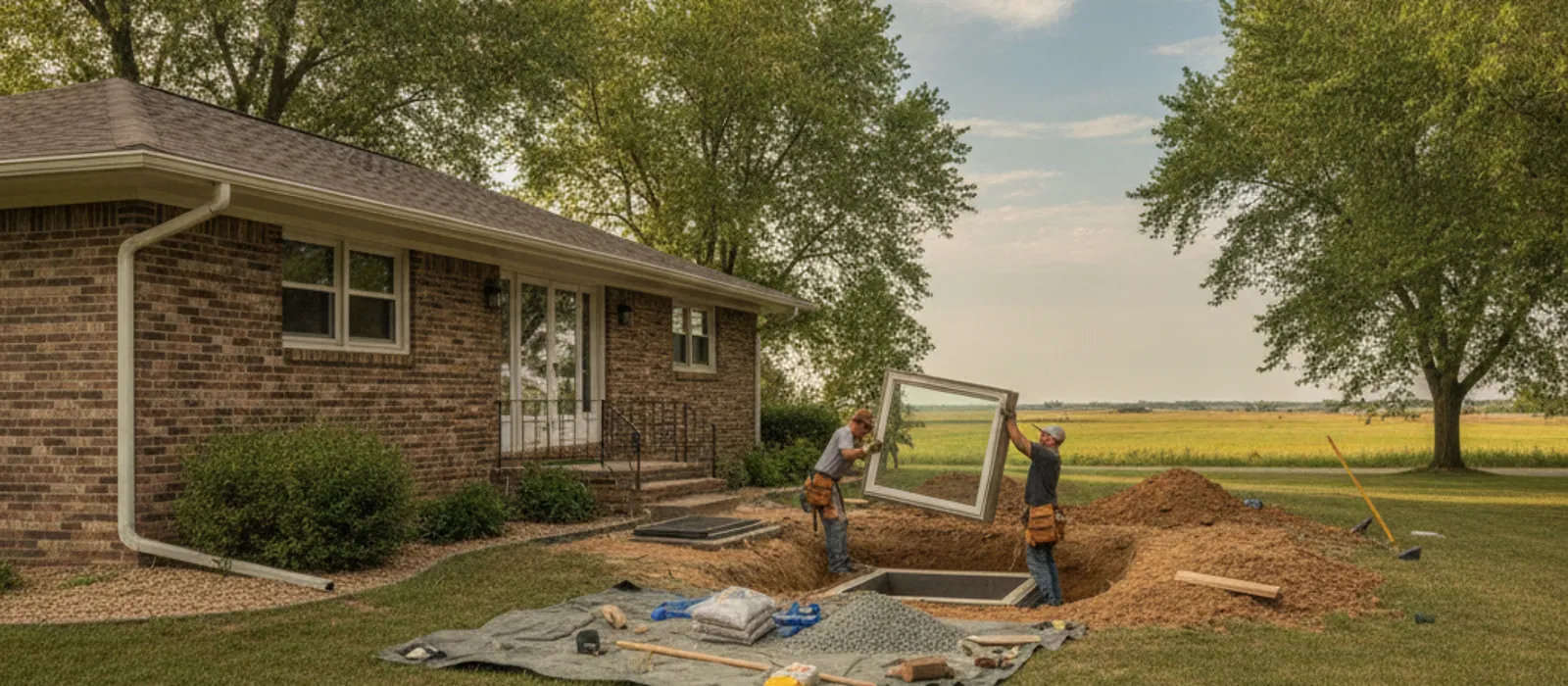
If you’ve tried these and water is still getting in, or if you can see rust-through, bowing, or cracks in the well wall itself, that’s your signal to stop DIYing and call a professional. Cutting concrete, repairing a foundation crack, or working near any wiring that runs close to the window well isn’t a weekend project, and getting it wrong can turn a $600 fix into a $6,000 one. When it’s time for a proper fix, our window well installation service handles everything from a simple replacement to a full regrade and drain tie-in.
Ready to have someone take a look? Get a free written estimate or call (402) 261-0485 any time, including for closing-deadline inspections.
When It’s More Than a Leak
Sometimes a leaking window well is telling you about a bigger problem. A wall that’s visibly bowing inward, cracking mortar joints near the well, or soil that keeps sinking no matter how many times you refill it usually points to structural movement, not just bad drainage. We cover the warning signs in detail in bowing window well wall, and it’s worth reading if your well looks warped rather than just wet.
A well that floods completely during heavy rain, rather than just seeping, is its own category of problem, often tied to a footing drain that’s failed elsewhere along the foundation. If that’s your situation, flooded window well walks through what’s usually happening and what it takes to fix it for good.
There’s also a code angle worth knowing about if the window behind that well serves a bedroom. A basement bedroom in Lincoln isn’t legal, and isn’t sellable as a bedroom, without a code-compliant egress window and well. If your well has been leaking for years and you’re not sure the whole setup even meets current code, it’s worth having it checked alongside the drainage issue. Fixing the leak and finding out later the well doesn’t meet egress requirements means paying for the work twice. Our egress window replacement service can confirm whether your current window and well meet code while we’re already out there fixing the leak.
What It Costs to Fix a Leaking Window Well
Pricing depends entirely on whether you’re dealing with drainage, the cover, or the well itself. Here’s what we typically see across Lincoln and the surrounding counties.
| Problem | Typical Fix | Cost Range |
|---|---|---|
| Clogged or missing drain | Clean out or add drain tie-in | $200-$600 |
| Cracked or missing cover | New cover installed | $150-$600 |
| Bad grading | Regrade and compact soil | $150-$500 (DIY often free) |
| Rusted or bowing well | Full window well replacement | $600-$1,500 |
| Failed seal at foundation | Reseal joint | $150-$400 |
| Window itself is compromised | Basement window swap | $400-$1,200 |
| Egress opening needs full replacement | New egress cut-in with well | $3,500-$7,000 (full quotes commonly $5,500-$9,500) |
A Lincoln building permit, if your fix involves structural or code-related work, typically runs $75-$200 on top of the project cost. We handle the permit paperwork on any job that needs one.
Preventing the Next Leak Before It Starts
Once a leak is fixed, a little seasonal maintenance keeps it fixed. Clear debris out of the well every fall before leaves pile up, and again in early spring before the heavy rains start. Check that the cover is seated tightly and hasn’t cracked over winter, since freeze-thaw cycles are hard on plastic and older acrylic covers especially. We go into the seasonal side of this in nebraska freeze-thaw window well damage, which explains why so many leaks show up right after the first real thaw of the year.
It’s also worth walking the perimeter of your foundation once a year to check grading, since soil settles gradually and a slope that was fine three years ago can flatten out or even reverse without you noticing. Standing water anywhere near a foundation for extended periods creates conditions for mold growth, something the EPA covers in detail on its mold and moisture guidance if you want to understand the health side of a chronically wet basement.
If you’re not sure where to start, a quick inspection is usually faster than guessing. We do free written estimates for exactly this reason, so you know what you’re dealing with before you spend a dollar.
Frequently Asked Questions
Why does my window well only leak during heavy rain, not light rain?
Most window wells can handle a normal drizzle just fine because the drain or gravel bed keeps up with the water. Heavy rain overwhelms a partially clogged drain or bad grading faster than it can drain away, which is why the leak seems to come and go with storm intensity rather than happening every time it rains.
Can I just fill my window well with gravel to stop the leaking?
Adding gravel helps with drainage but won’t fix the underlying cause if the drain is clogged, the grading is wrong, or the well itself has a gap or crack. It’s a reasonable first step, but if water keeps coming in after you’ve added gravel, something else needs attention.
How much does it cost to fix a leaking window well in Lincoln?
Simple fixes like clearing a drain or replacing a cover run $150-$600. A full window well replacement typically costs $600-$1,500. If the leak turns out to be tied to a failing egress opening that needs a complete replacement, costs run $1,200-$3,000 for an existing opening or $3,500-$7,000 for a new cut-in.
Is a leaking window well a sign of a bigger foundation problem?
Sometimes, but not usually. Most leaks are drainage or cover issues that have nothing to do with the foundation. The signs to watch for are a visibly bowing well wall, cracking mortar near the well, or soil that keeps sinking no matter how much you refill it, since those point to structural movement rather than a simple leak.
Still seeing water after a storm? Reach out here or call (402) 261-0485 and we’ll get you a free written estimate, no obligation.