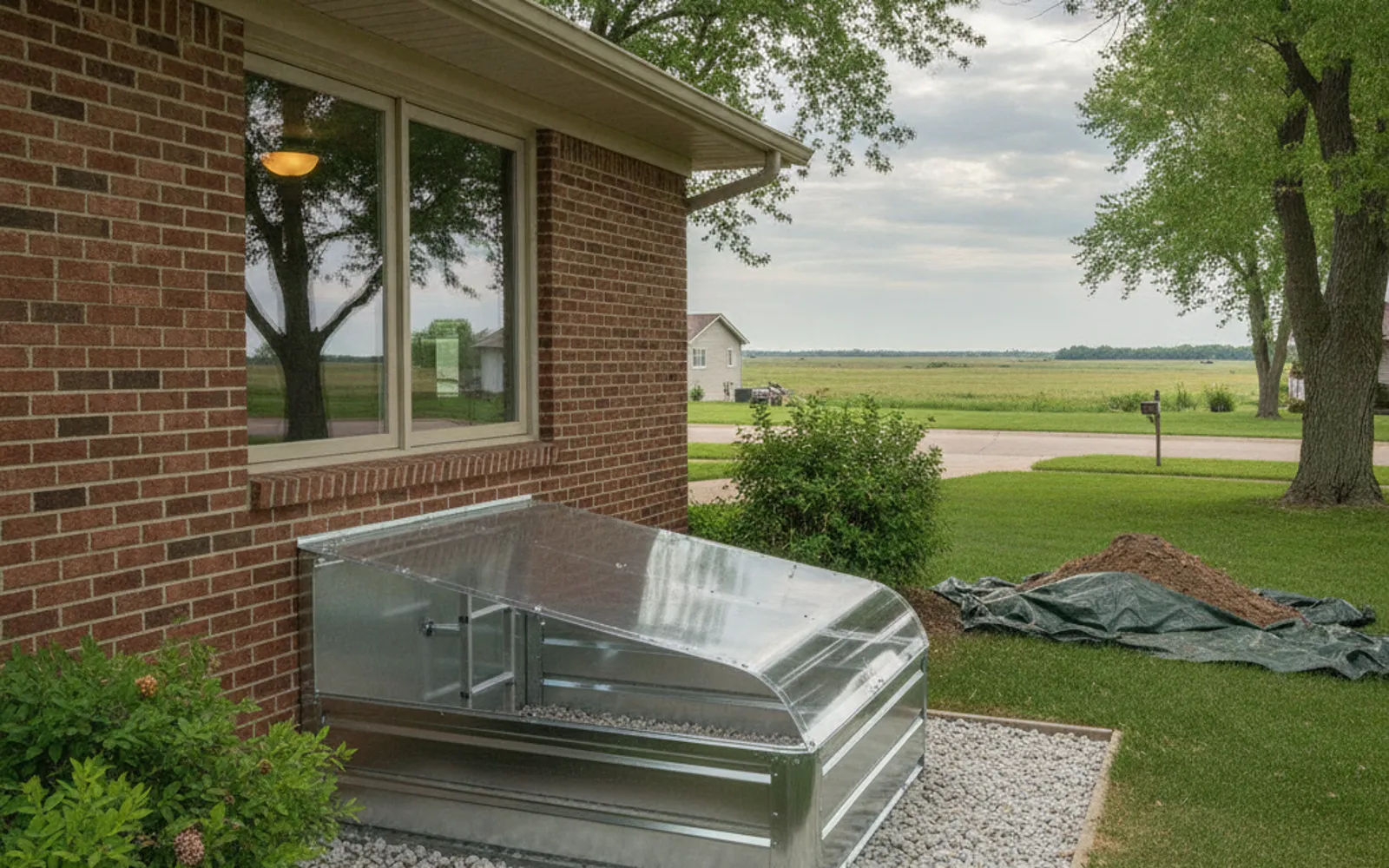
Galvanized steel and composite window wells built for Lincoln's clay soil, with covers, escape ladders, and drainage that actually keeps water out of your basement.
A basement window is only as good as the well around it, and in Lincoln that well has to fight Nebraska clay soil and hard freeze-thaw swings every winter. We handle window well installation in Lincoln for new egress openings and for older wells that have started to rust, collapse, or fill with water after every heavy rain. Most jobs run $600 to $2,500 depending on well size, material, and how much drainage work the site needs.
We install galvanized steel and composite wells sized to code for both standard basement windows and full egress window installations, plus covers and escape ladders where local code calls for them. Call (402) 261-0485 for a free written estimate, and we'll tell you straight whether your existing well needs a repair or a full replacement.
Corrugated galvanized wells resist rust and hold their shape under Lincoln's freeze-thaw cycles, and they're the most budget-friendly option for standard basement windows.
Composite wells won't rust or dent and blend in better against brick or stone foundations, a common upgrade for homeowners doing a full egress conversion.
A well cover keeps rain, leaves, and debris out between storms and adds a layer of child and pet safety without blocking light or emergency access.
Wells deeper than about 44 inches need a permanently fixed ladder or steps so the window still works as a code-compliant fire escape.
We set every well on a compacted gravel base with proper depth below the window sill, so water has somewhere to go instead of pooling against your foundation.
Where a home already has a foundation drain tile system, we connect the well drain into it so well water routes away from the house instead of sitting in the pit.
Galvanized steel is the standard choice for most Lincoln homes because it's affordable, holds up well structurally, and is easy to size for any window width. It's the material we use most often on straightforward window well installation jobs where the goal is solid function at a fair price.
Composite and heavy-duty polyethylene wells cost more but never rust, which matters most on homes near sprinkler zones or low spots where the well stays damp. They also come in colors and textures that match brick or stone better than bare metal, which some homeowners want when the well is visible from the street or a patio.
Either material can be paired with a cover and ladder, and both are sized for standard basement windows as well as larger egress window replacement projects. We'll walk you through the tradeoffs on-site based on your foundation, soil, and budget.
A well cover isn't just about looks. It keeps rain and yard debris from filling the pit, cuts down on window well flooding, and adds a physical barrier over a hole that's easy for a kid or pet to fall into. We install clear polycarbonate covers, bubble covers for taller wells, and flat covers depending on the well depth and how much headroom you need. Our window well covers page covers cover types, pricing, and the inside-release rule for egress wells.
If you're not sure whether your current well meets code, that's a quick check we can do during a free estimate.
Drainage is the part of window well installation that determines whether the well works for ten years or floods after the first hard rain. We dig each well below the window sill and backfill with a compacted gravel base, usually eight to twelve inches, so water percolates down instead of collecting against the glass and frame.
On homes with an existing foundation drain tile system, we tie the well drain directly into it, which routes water away from the foundation instead of relying on gravel alone to soak it up. This is especially important on Lincoln's clay-heavy lots, where soil doesn't drain fast and water has a tendency to sit right where you don't want it.
We also grade and slope the well opening away from the foundation wall so surface runoff doesn't pour straight into the pit every time it rains.
Lincoln's clay soil expands and contracts hard through freeze-thaw cycles, and that movement is the number one reason wells start to lean, buckle, or pull away from the foundation over a few winters. Once a well shifts, gaps open up along the wall and water finds its way straight into your basement instead of draining down through gravel.
A flooded window well usually means the drainage layer has clogged with silt, the gravel base has settled, or there's no drain tile connection at all. In most cases we can rebuild the drainage without replacing the whole well, though a well that's visibly rusted through or structurally bent needs full replacement to hold back the soil around it.
If you're dealing with standing water or a well that's noticeably tilting, don't wait, since ongoing pressure against a compromised well can lead to foundation window damage. Learn more about typical pricing on our egress window cost page, or call for a same-week inspection.
Most window well installations in Lincoln run $600 to $2,500 depending on well material, size, and whether drain tile tie-in or extra excavation is needed. A basic galvanized well replacement sits at the lower end, while a larger composite well with a cover and ladder for a full egress window lands toward the higher end. We give a firm written number after a free on-site look.
It's almost always a drainage problem: a clogged or missing gravel base, a settled well that's no longer sloped correctly, or no connection to your foundation's drain tile system. Lincoln's clay soil makes this worse because it drains slowly on its own. We rebuild the base and tie into drain tile where available to fix it for good instead of just re-digging the same pit.
It's not always required by code, but we recommend one on almost every well because it blocks rain and debris that cause flooding and adds a safety barrier over the opening. Clear and bubble covers still let in light and don't interfere with using the window as an emergency exit.
Nebraska building code generally requires a permanently fixed ladder once a window well is deeper than about 44 inches, so the window still functions as a code-compliant escape route. We check well depth as part of every inspection and add a ladder if yours doesn't have one.
Sometimes. If the well itself is still structurally sound but has shifted from freeze-thaw movement or lost its gravel base, we can often reset it and rebuild the drainage for less than a full replacement. If the metal is rusted through or the well is visibly bent, replacement is the safer long-term fix. We'll give you an honest read during the estimate rather than upselling a replacement you don't need.
Free written estimates. Emergency calls answered around the clock.