
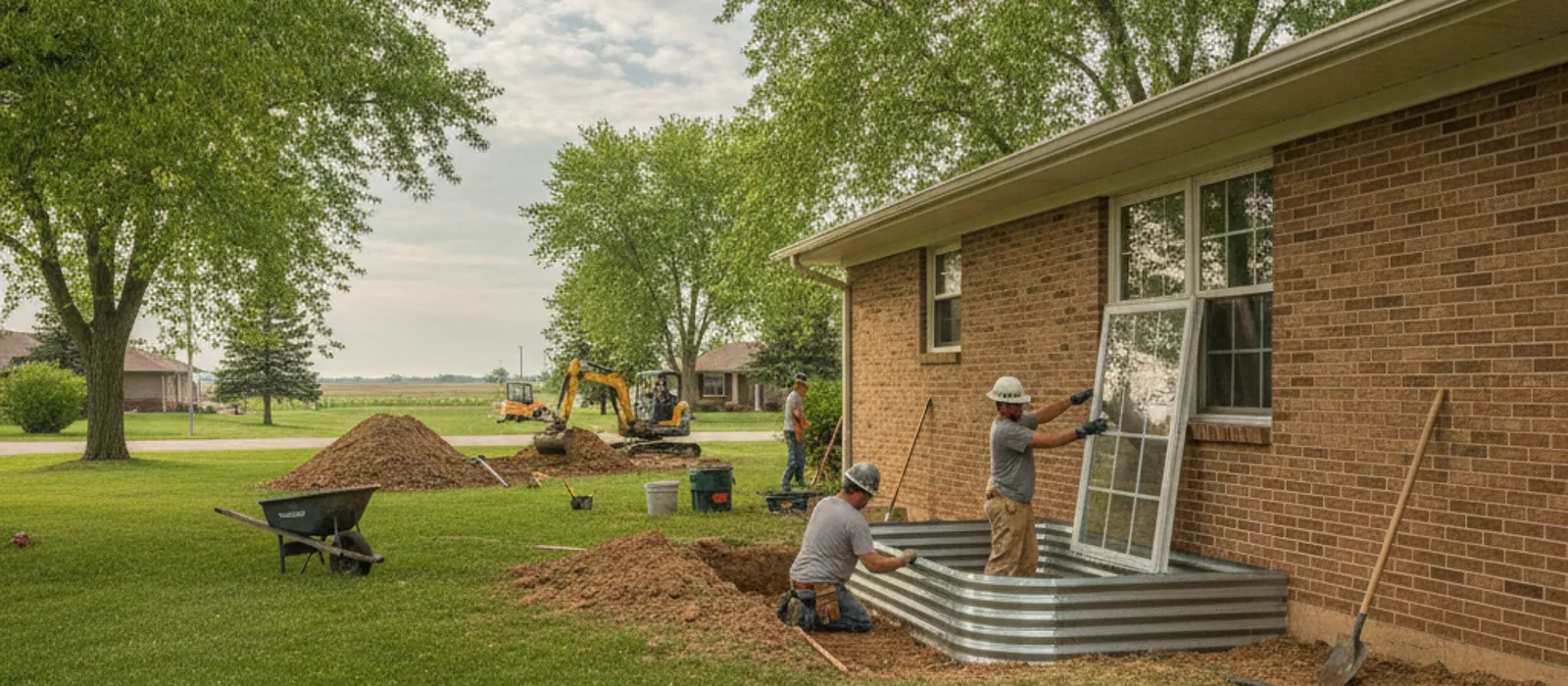
Look at your basement window well from a few feet back. Does the wall curve inward like someone is pushing on it from the outside? That’s not your imagination, and it won’t fix itself.
Window well wall bowing is one of the clearest signs that soil pressure, rust, or bad drainage is winning the fight against your well. Left alone, a bowing wall can crack, buckle, or collapse into the window itself. In Lincoln and the surrounding towns, we see this most in older corrugated steel wells that have been in the ground since the house was built.
The good news is that a bowing wall almost never means your foundation is in danger. It usually means the well itself has failed and needs to be replaced or reinforced. Here’s what causes it, how to tell how bad it is, and what it actually costs to fix in Southeast Nebraska.
If your well wall is already curved more than an inch or two, don’t wait on this one. Contact us or call (402) 261-0485 for a free look and a written estimate before the situation gets worse.
What Causes Window Well Wall Bowing
A window well is basically a thin metal or plastic shield holding back a wall of dirt. When that dirt pushes harder than the well can resist, the wall bows. There are a handful of usual suspects.
Saturated soil. Nebraska clay soil expands when it’s wet and contracts when it dries out. After heavy spring rain or fast snowmelt, saturated clay can weigh far more than dry soil and push directly against the well wall. This is the single biggest cause of window well wall bowing we see on service calls.
Freeze-thaw cycling. Water that seeps into the soil around a well freezes in the winter and expands. Cycle that enough winters in a row and the repeated pressure will slowly warp even a well that was installed correctly. Nebraska’s freeze-thaw swings are hard on wells the same way they’re hard on driveways and sidewalks.
Rust and corrosion. Corrugated galvanized steel wells were standard for decades, and most of them are still doing their job. But once the galvanized coating wears through, rust weakens the metal fast. A rusted well has far less strength to resist soil pressure, so it bows and then tears.
Poor backfill or compaction. If the soil around the well wasn’t compacted properly during the original install, it settles unevenly over time. That uneven settling puts uneven pressure on the wall, which is why some bowing walls curve more on one side than the other.
Undersized or thin-gauge wells. Cheaper wells use thinner metal or lighter plastic that simply isn’t built for Nebraska soil conditions. They may look fine for a few years and then bow suddenly once the soil gets saturated.
Warning Signs Your Window Well Wall Is About to Fail
You don’t need to be a contractor to catch this early. A few things to check next time you’re outside.
- A visible curve or dent in the well wall, especially near the middle
- Rust streaks or flaking metal on a corrugated steel well
- Gaps opening up between the well and the foundation wall
- The well cover no longer sitting flat or snapping into place
- Cracking or bulging in the basement wall directly behind the well
- Water pooling inside the well after every rain instead of draining
Any one of these on its own is worth a phone call. If you’re seeing two or three together, treat it as urgent. A bowing wall that’s also cracking the foundation behind it is a different, more expensive problem than a bowing wall that just needs a new well.
It also helps to know how fast this tends to move. A well that’s holding steady with a slight curve might sit stable for a season or two if the drainage around it is decent. A well that’s visibly worsening after every rain is on a much shorter clock, sometimes just a few months before it starts affecting the window frame itself.
Corrugated Steel vs. Poly vs. Precast: Which Wells Resist Bowing
Not all window wells handle Nebraska soil the same way. If you’re replacing a bowed well, the material you choose affects how long it lasts before you’re dealing with this again.
| Material | Typical Lifespan | Bowing Risk | Replacement Cost Range |
|---|---|---|---|
| Corrugated galvanized steel | 15-25 years | High once rust starts | $600-$1,100 |
| Powder-coated steel | 20-30 years | Moderate | $700-$1,200 |
| Heavy-gauge polyethylene (poly) | 25+ years | Low, won’t rust, can flex under extreme pressure | $650-$1,300 |
| Precast concrete | 40+ years | Very low | $1,000-$1,500 |
Corrugated steel is still the most common well in older Lincoln neighborhoods because it was the standard for so long. Poly wells have become popular for replacements because they don’t rust and hold up well through freeze-thaw cycles. Precast concrete costs more upfront but is close to a permanent fix.
Whatever material you land on, proper backfill and drainage still matter more than the well itself. A great well installed on wet, poorly compacted soil will eventually bow too.
Real Lincoln-Area Bowing Window Well Repairs and What They Cost
Here’s what this actually looks like on real houses around here.
In Waverly, a homeowner named Dan noticed his 1980s corrugated well had a noticeable inward curve after a wet April. Up close, the rust was worse than it looked from a distance, with several holes near the base. We pulled the old well, regraded the backfill, and installed a new powder-coated steel well for $950, finished in an afternoon.
Out in Hickman, the Petersons had heavy clay soil pushing their well wall in almost two inches on one side, enough that the window itself was starting to bind. That job needed a full well replacement plus regrading and a new gravel drainage bed underneath, which ran $1,400 total. Two years later, the wall is still straight.
In Beatrice, Maria’s well wasn’t bowed badly yet, just starting to curve after spring flooding backed water up against it. Because we caught it early, a $600 poly well swap and about $200 in drainage correction solved it before it became a bigger job. That’s the range you want to land in if you catch a bowing wall in its early stages.
Across most Lincoln-area jobs, straightforward window well replacement runs $600 to $1,500, depending on well material and how much drainage work is needed. If the bowing has already cracked the foundation wall behind it, that’s a separate structural repair and a different conversation, one that usually needs a foundation specialist alongside the window well work.
Waiting rarely saves money. What starts as a $600-$800 well swap can turn into a $1,400+ job once soil keeps pushing and the frame around the window starts to warp too. Reach out to our team for a free written estimate before a small bow becomes a bigger repair.
DIY Fixes vs. When to Call a Professional
A little bit of DIY is fine here. Clearing debris out of the well, adding a layer of gravel at the base for drainage, or sealing small gaps at the foundation joint are all reasonable weekend jobs.
What’s not a good DIY project:
- Removing and replacing the well itself, since it usually means disturbing the soil right against your foundation
- Any digging near gas lines, electrical conduit, or existing drainage pipe
- Straightening or reinforcing a wall that’s already bowed more than an inch, since that can hide a cracked foundation wall behind it
- Anything that involves cutting concrete or altering the window opening
If your well wall is bowing enough to touch or bind the window, or if you see cracking in the foundation wall itself, stop and call a professional. That’s not a place to save money on labor, because a mistake there can turn a well repair into a foundation repair. Call (402) 261-0485 any time, including for urgent inspections before a home sale deadline.
A licensed contractor will also know how deep to dig without undermining the footing next to the well, how to compact new backfill correctly, and how to tie the new well back into the foundation so it doesn’t just bow again in a year or two. That last part is where a lot of cut-rate repairs fall short.
Why This Matters If You’re Selling Your Home
A bowing window well wall isn’t just cosmetic if that window serves a basement bedroom. Egress windows have to open fully and stay clear of obstruction to meet code, and a wall that’s pushed in far enough to bind the window can knock that bedroom out of compliance.
Home inspectors in Lincoln and Lancaster County flag bowing wells regularly, and buyers notice too. A $600-$1,500 repair now is a lot easier to absorb than a price cut or a failed inspection contingency during closing. If you’re planning to list your house in the next year, it’s worth getting the well checked well before it goes on the market.
Stopping a Bowing Window Well Wall Before It Starts
If your well is still straight, a little prevention goes a long way in this climate.
Keep the grade sloping away from the well. Water should run away from the foundation, not toward it. Regrading around a well is often a $100-$300 fix that prevents a $1,000+ repair down the road.
Add or refresh gravel drainage at the base. A proper gravel bed under the well lets water drain down instead of pooling against the wall. This is standard practice on any new window well installation we do in Lincoln.
Use a well cover. A cover keeps rain, leaves, and snowmelt from filling the well directly. It’s a small cost, usually $150-$600 installed, against a much bigger repair bill.
Choose the right material for a replacement. If you’re already replacing a well, poly or precast will hold up better against Nebraska’s clay soil and freeze-thaw swings than a bargain corrugated steel option.
Watch it after big storms. A five-minute check after heavy rain is the easiest way to catch bowing while it’s still a small fix.
If you’re not sure whether your well needs full replacement or just drainage work, our team handles both egress window installation and standalone window well repair across Lincoln, Waverly, Hickman, Seward, Crete, Beatrice, and Ashland. For related reading, see our posts on how window well drainage actually works, what causes rusted window wells, and Nebraska freeze-thaw window well damage.
According to the National Weather Service office serving Lincoln, this region regularly sees intense spring rain events that saturate soil quickly, which is a major driver of the pressure that bows window wells (weather.gov/oax). The USDA’s soil survey tools also show much of Lancaster and Gage County sitting on clay-heavy soils prone to expansion when wet, which explains why bowing shows up so often in this area (websoilsurvey.nrcs.usda.gov).
Frequently Asked Questions
Can a bowing window well wall be straightened instead of replaced?
Sometimes, if the bow is minor and caught early, a contractor can pull the well back into position and reinforce it with new anchoring or backfill. Once metal has rusted or bent more than an inch or two, though, replacement is almost always the safer and more cost-effective fix.
Does a bowing window well mean my foundation is failing?
Not usually. A bowing well wall is a separate structure from your foundation, and most of the time it just means the well itself is under too much soil pressure. If you also see cracking in the actual basement wall behind the well, have that checked separately since it could point to a foundation issue.
How much does it cost to fix a bowing window well wall in Lincoln?
Most window well replacements in the Lincoln area run $600 to $1,500, depending on material and how much drainage correction is needed. Catching the problem early, before the wall touches the window frame, tends to keep the job on the lower end of that range.
Will home insurance cover a bowing window well?
It depends on your policy and what caused the damage. Gradual soil pressure and normal wear typically aren’t covered, while sudden damage from a specific storm event sometimes is. It’s worth a quick call to your agent, but most homeowners end up paying for this repair out of pocket.