
Six inches of rain in one night and now there’s a brown puddle creeping across your basement carpet. If you’re dealing with window well flooding basement damage right now, you don’t have time for theory. You need to know what to grab, what to check, and what actually stops the water for good.
This happens more than most Lincoln homeowners realize. A window well is basically a hole in the ground next to your foundation, and if the drainage underneath it fails or the grading around it is off, that hole fills up like a bucket. Once it overflows the rim or pushes against the window seal, the water goes exactly where you don’t want it.
Below is what to do in the first hour, what causes the problem, and the fixes that keep it from becoming a repeat event. If the water is rising fast and you can’t get ahead of it, call us at (402) 261-0485 and we’ll walk you through it or get someone out to you.
Emergency Fixes for Window Well Flooding Basement Water Right Now
First, stay away from any electrical outlets or panels near the flooded window if you can avoid it. Standing water and electricity are a bad combination, and that’s not a spot to improvise.
If the well is actively overflowing:
- Bail or pump it out. A wet/dry shop vac or a small submersible pump will move water faster than a bucket. Get the level below the window’s bottom seal first.
- Check the window seal from inside. If water is seeping around the frame rather than pouring in, towels and a shop vac inside can buy you time while the well drains.
- Clear the well drain if you can see it. Leaves, mulch, and dirt clog the gravel or drain opening at the bottom of most wells. A gloved hand or a small trowel can sometimes open it back up in minutes.
- Divert surface water. If a downspout or a low spot in your yard is dumping water straight into the well, a temporary sandbag or a redirected splash block can cut the flow while you wait for a permanent fix.
- Cover it if rain is still falling. A scrap piece of plywood or a tarp weighted down over the well (not sealed, just deflecting rain) can slow the intake in a pinch.
None of this fixes the underlying problem. It just keeps you from losing more of your basement tonight. For anything beyond bailing and clearing debris, especially if you smell sewer gas, see cracks in the foundation, or the water isn’t going down at all, stop and reach out to our team. Some of what looks like a simple clog is actually a collapsed drain line, and digging into that yourself can make it worse.
Why Window Wells Flood in the First Place
Most flooding cases we see in Lincoln and the surrounding towns come down to one of four things.
A dead or clogged drain. Window wells are supposed to tie into either a gravel bed that lets water percolate away or a drain line connected to your sump system. Over ten or fifteen years, that gravel bed silts up and stops absorbing water the way it used to.
Bad grading. If the ground around your foundation slopes toward the well instead of away from it, every rain sends runoff straight into the pit. This is one of the most common issues we find on older homes in Lincoln’s established neighborhoods.
No cover, or a cracked one. An open well collects rain, snowmelt, and leaves directly. A cracked or missing cover means the well fills every time it storms, which is a big part of why window well flooding basement calls spike every spring.
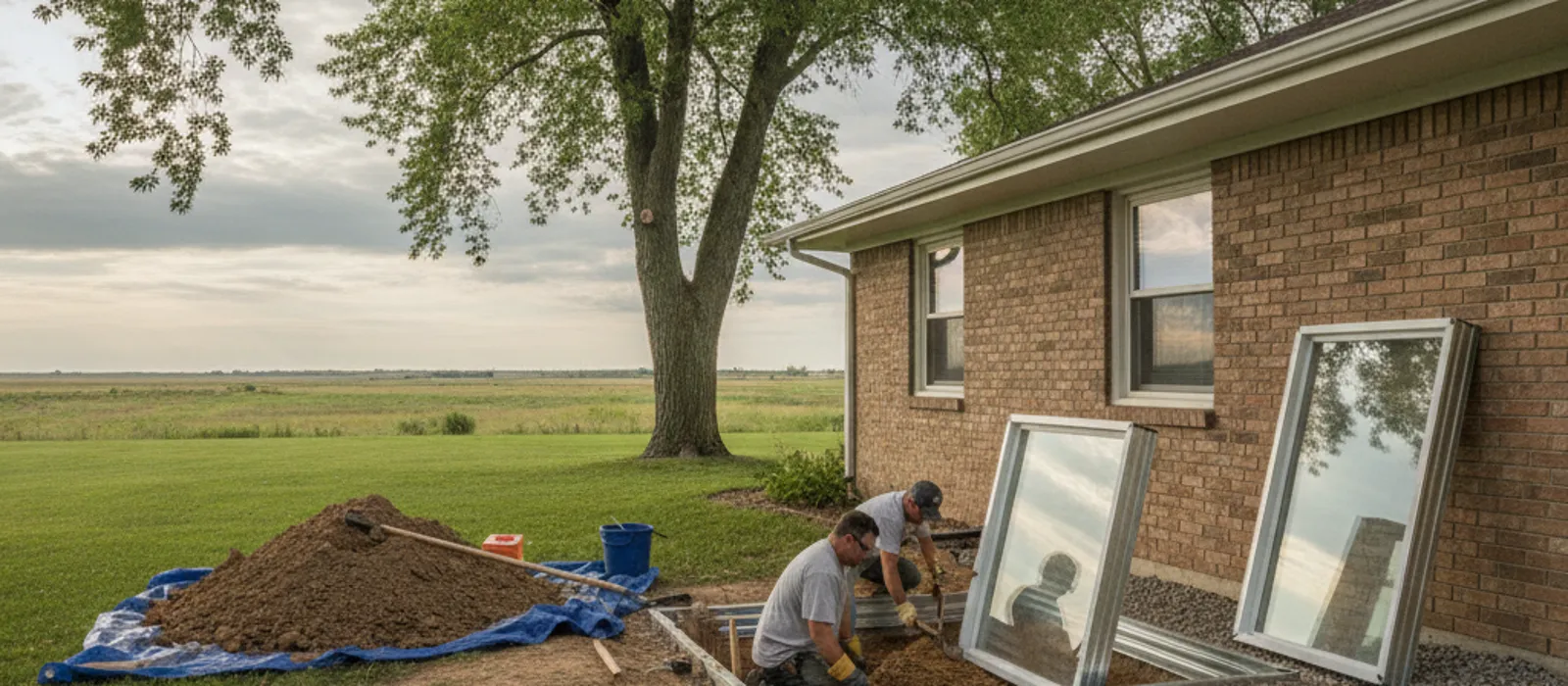
Undersized or missing wells. Some older homes have basement windows with barely any well at all, just a shallow depression that was never built to handle real drainage. In some cases the fix isn’t a repair. It’s a proper window well installed correctly the first time.
Real Situations from Around Lincoln
Dana in Crete called us after two straight nights of thunderstorms left three inches of water sitting in her basement bedroom’s window well, right up against the glass. The drain underneath had never been connected to anything, it was just a well sitting on clay soil. We excavated, added a gravel bed with a proper drain tied into her existing sump line, and put in a new well liner. Total cost came to $1,450, on the low end because the window itself didn’t need work.
Over in Hickman, the Ostrander family had a different problem. Their grading had shifted over the years so that a corner of the yard funneled straight at the window well every time it rained. No amount of clearing the drain helped because the volume of water coming in was just too much. We regraded that section and added an extension to their downspout to carry water further from the foundation. That job ran about $900 and solved what three years of DIY patching hadn’t.
In Waverly, Tom found standing water in his window well every spring for two years running before he called. By the time we got there, the wood-framed basement window itself had started to rot from constant moisture exposure. We replaced the window well and swapped the window, since patching the well alone wouldn’t have fixed a frame that was already failing. That combined job landed around $2,700, which is more than either fix alone but a lot less than dealing with a full window failure later.
If any of these sound familiar, get in touch with us before the next storm rolls through. A lot of these fixes are faster and cheaper when they’re planned instead of done in a panic at 11pm.
How Window Well Drainage Is Supposed to Work
A properly built window well isn’t just a metal or plastic shell stuck in the ground. Underneath it should be a bed of coarse gravel, usually 12 to 18 inches deep, that lets water drain down and away from the foundation instead of pooling against it.
In many setups, that gravel bed connects to a perforated drain pipe that ties into your home’s foundation drain system or sump pump. When that connection is solid, rain and snowmelt disappear within a few hours instead of sitting there for days.
The window well cover matters more than people think too. A well-fitted, secured cover keeps out the bulk of rain and all of the leaf debris that eventually clogs the gravel bed underneath. Covers run $150 to $600 depending on size and material, and they’re one of the cheapest ways to prevent the next flood.
Long-Term Solutions That Actually Stop the Flooding
Once the immediate water is dealt with, here’s what actually keeps window well flooding basement problems from becoming a yearly event.
Rebuild the drainage bed. If your well has never had proper gravel and drain tie-in, this is the fix that matters most. It usually runs $600 to $1,500 depending on depth and whether it needs to connect to an existing sump system.
Regrade around the foundation. Dirt and landscaping settle over time. A slope that once carried water away from the house can end up sloping toward it within a decade. Nebraska Extension’s water resources has good background on managing runoff around a home if you want to understand the grading side before you call anyone. This is often a $300 to $900 fix and pairs well with a drainage rebuild.
Install or replace the well cover. A secured, properly sized cover keeps leaves and rain volume down dramatically. Clear covers also let daylight into the basement, which most homeowners like better than a solid one.
Replace an undersized or failing well. If the well itself is too small, rusted through, or was never built to code, a full window well replacement is usually the right call. That’s typically $600 to $1,500 for the well alone.
Address the window if it’s compromised. Wood-framed basement windows that have taken on water repeatedly often need replacement, not just the well around them. A basement window swap runs $400 to $1,200, while a full egress window replacement in an existing opening is $1,200 to $3,000.
If your basement bedroom doesn’t have a legal egress window at all, flooding is often the least of your problems. A code-compliant egress window with a properly built well is a new cut-in project, typically $3,500 to $7,000 for the opening and window, with full Lincoln installs including the well and interior finishing commonly landing at $5,500 to $9,500. Add a Lincoln building permit at $75 to $200 on top of that.
Cost Comparison: Common Window Well Flooding Fixes
| Fix | Typical Cost | Best For |
|---|---|---|
| Clear and reconnect drain | $150 - $500 | Minor clogs, well drains but slowly |
| Rebuild gravel drainage bed | $600 - $1,500 | No working drain tie-in, recurring pooling |
| Regrade around foundation | $300 - $900 | Runoff flowing toward the well |
| New window well cover | $150 - $600 | Open wells collecting rain and debris |
| Full window well replacement | $600 - $1,500 | Rusted, cracked, or undersized well |
| Basement window swap | $400 - $1,200 | Window frame damaged by repeated moisture |
| New egress cut-in with well | $3,500 - $7,000 | No legal egress exists, bedroom code compliance needed |
When to Stop and Call a Professional
A shop vac and a bag of gravel handle a lot of small problems. Some situations are past that point.
If the drain pipe underneath the well has collapsed or was never connected to anything, that’s underground work that needs to be dug up and done right, not patched from the surface. If you see cracking or bowing in the well wall itself, that’s a structural issue, not a drainage one, and it can get worse fast if water keeps pushing against it.
Anything involving concrete cutting for a new drain tie-in, or work near electrical panels and outlets in a flooded basement, is a job for a licensed contractor. The EPA’s guidance on cleaning up after water damage is worth a read too, since standing water that sits more than 24 to 48 hours creates a real mold risk regardless of what caused the flood.
We offer free written estimates and can usually tell within one visit whether you’re looking at a $150 drain clearing or a full well rebuild. Call (402) 261-0485 or request an estimate and we’ll give you a straight answer either way.
If the clog is the main issue, see our guide on window well drain clogged. If you want to get ahead of the next storm season entirely, spring window well flooding prevention walks through a seasonal checklist. Nebraska’s freeze-thaw cycles do their own damage too, which we cover in nebraska freeze-thaw window well damage.
For drainage-focused installs, see our window well installation page, and if the window itself needs replacing after water damage, our basement window replacement page covers what that involves.
Frequently Asked Questions
How fast can a window well flood a basement?
Faster than most people expect. In a heavy thunderstorm, an unprotected well with no working drain can fill and overflow within 30 to 60 minutes. If the well sits below your window’s sill height even briefly, water can push past the seal and into the basement.
Is window well flooding covered by homeowners insurance?
It depends on your policy and what caused it. Many standard policies exclude water that enters from the ground or through window wells unless you have specific water backup or flood coverage. Check with your insurance agent before you assume it’s covered, and keep photos of the damage either way.
Can I fix a flooded window well myself?
Clearing debris, bailing water, and adding a cover are reasonable DIY tasks. Rebuilding a drainage bed, tying into a sump line, or any concrete cutting is better left to a contractor, since mistakes underground are expensive to undo and can affect your foundation.
Will a sump pump stop my window well from flooding?
A sump pump helps if your window well drain is properly connected to it, but it won’t fix a well that has no drain tie-in at all or one sitting in bad clay soil. In most cases the well itself needs a proper gravel bed and drain before a sump pump can do its job.