
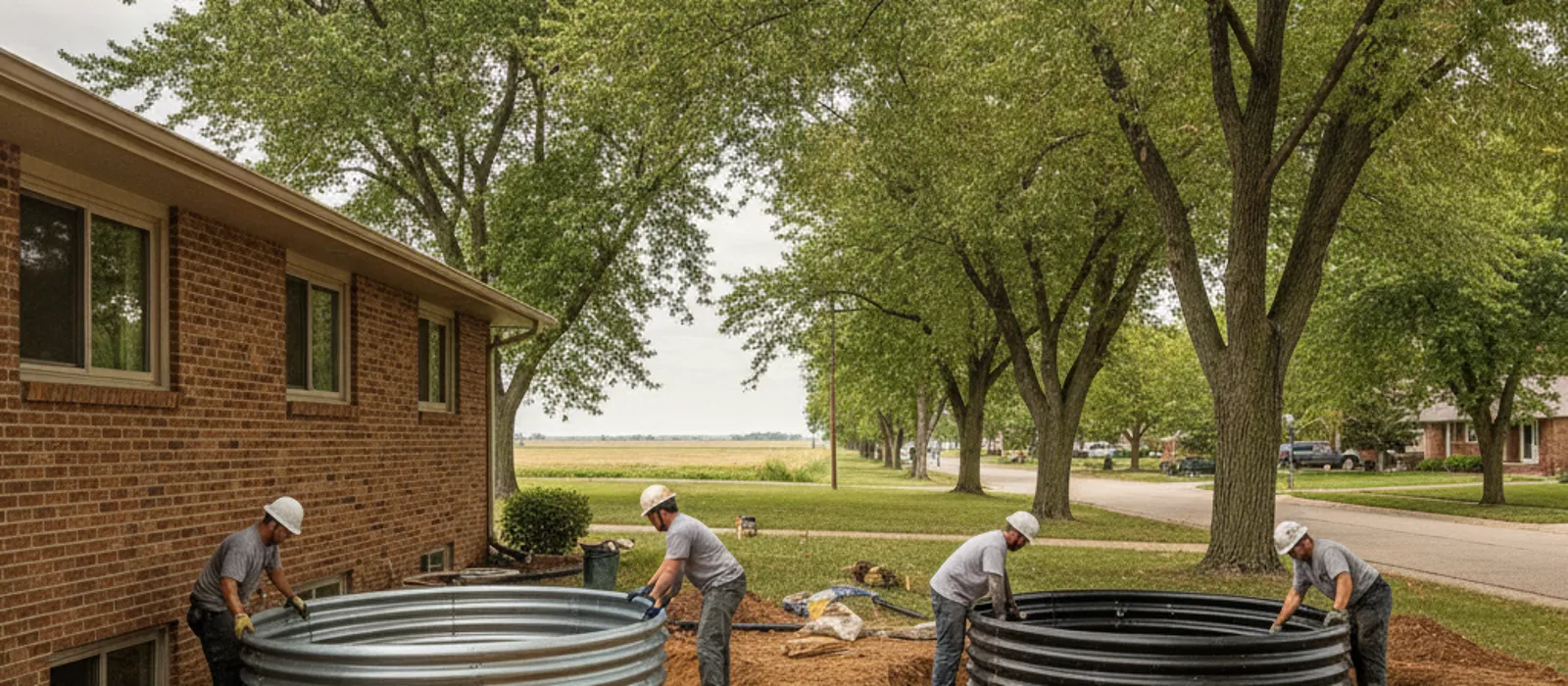
Picture two houses on the same Lincoln street, built the same year, with the same size basement bedroom. One owner is still using the original window well. The other has replaced theirs twice. The difference usually comes down to one thing: material.
If you’re staring at a rusted-out well or shopping for a new egress installation, the steel vs polyethylene window well question is worth ten minutes of research before you spend a dime. The wrong pick in our climate means paying for a replacement years earlier than you should. The right pick can outlast the house’s next two owners.
We’ve pulled corrugated steel wells that lasted eight years and others that held up for thirty. We’ve also seen polyethylene wells crack after one hard Nebraska winter and others still holding strong a decade later. Material matters, but so does thickness, installation, and how much water the well handles every spring.
If you’d rather skip the research and just get a straight answer for your house, call (402) 261-0485 or request a free written estimate. We’ll tell you what we’d install on our own home.
Steel Window Wells: Strength With a Rust Clock Ticking
Corrugated galvanized steel is the material most Lincoln homes already have. It’s been the standard for decades because it’s strong, holds soil pressure well, and comes in enough sizes to fit almost any opening.
The catch is right there in the name: steel. Even galvanized steel is coated zinc over metal, and that coating wears thin over time, especially where the well sits in wet soil or gets splashed by roof runoff. Once the coating breaks down, rust starts, and it doesn’t stop on its own.
Denise Ostrom in Waverly called us in April after noticing orange streaks running down the inside of her window well wall. The well was original to her 1998 house, 27 years old, and had done its job for a long time. The steel had thinned enough at the base that we could see daylight through two small holes. We replaced it with a new galvanized well for $1,150, well within the typical $600 to $1,500 range for a straightforward swap.
That’s actually a solid run for steel. Some wells rust through in half that time if the site drains poorly or the galvanizing was thin to begin with. Once rust perforates the metal, soil starts working its way through the gaps, and the well can eventually pull away from the foundation.
Steel pros: high strength, handles heavy soil loads, widely available, familiar to inspectors and appraisers. Steel cons: vulnerable to rust, especially at the base and weld seams; heavier to handle during installation; can look worn faster even when structurally fine.
Polyethylene Window Wells: Won’t Rust, But Nebraska Winters Test Them Hard
Polyethylene wells are the newer option, molded from UV-stabilized plastic instead of stamped metal. They can’t rust, which sounds like an easy win, and for a lot of homeowners it is. No rust means no orange streaks, no thin spots, no pinhole leaks twenty years down the road.
But plastic has its own weak point in our part of the country: temperature swings. A polyethylene window well that spends a January afternoon at 15 degrees and then sits in direct sun can flex and stress at the seams. Over enough freeze-thaw cycles, cheaper or thinner polyethylene wells can crack, usually at the corners or where the well bolts to the foundation.
Mark Reinke in Hickman bought a house in 2023 with a polyethylene window well already installed by a previous owner. It looked fine at closing. By his second winter, he noticed a hairline crack near the top edge that widened every time the ground froze and thawed. We swapped it for a heavier-gauge steel well for $1,300, partly because his site had good drainage and low rust risk, and partly because he wanted the extra rigidity for a well that also serves as a step-in exit.
Not every polyethylene well fails that way. Thicker, well-supported polyethylene wells hold up fine in Lincoln, Seward, and Crete when they’re properly anchored and the backfill is compacted correctly. The failures we see are almost always tied to thin material, poor anchoring, or a well that was undersized for the soil pressure behind it.
Polyethylene pros: never rusts, lighter to install, often smoother interior that resists algae buildup, good UV-stabilized versions last well. Polyethylene cons: can crack in extreme freeze-thaw cycling if undersized or poorly anchored, less rigid under heavy soil pressure, fewer size options for unusual openings.
Steel vs Polyethylene Window Well: Side-by-Side Comparison
| Factor | Steel Window Well | Polyethylene Window Well |
|---|---|---|
| Typical lifespan (Lincoln climate) | 15-30 years, depending on coating and drainage | 15-25 years with UV-stabilized, heavier-gauge material |
| Main failure mode | Rust and corrosion at the base and seams | Cracking at corners or anchor points during freeze-thaw |
| Weight | Heavier, may need two installers | Lighter, easier one-person handling for smaller sizes |
| Soil pressure handling | Excellent for deep or heavily backfilled wells | Good for shallow to moderate wells, weaker under heavy pressure |
| Appearance over time | Can look worn even if structurally sound | Holds color and finish well, no rust streaks |
| Typical replacement cost | $600-$1,500 | $600-$1,500 (comparable, some premium brands run higher) |
| Best fit | Deep wells, clay-heavy soil, standard rectangular openings | Shallow to mid-depth wells, sites with good drainage |
Which Material Actually Lasts Longer in Lincoln and Southeast Nebraska?
There’s no universal winner. Soil type, drainage, and installation quality change the answer more than the material itself does.
If your lot has heavy clay soil, which is common in older Lincoln neighborhoods and parts of Seward County, steel handles the sustained pressure better. Clay expands when wet and contracts when dry, and that constant push against the well wall favors steel’s rigidity.
If your site drains well and you’re more worried about long-term corrosion than soil pressure, a quality polyethylene well is a strong choice. Sandier soil around parts of Ashland and Crete drains faster and puts less stress on a plastic well’s seams.
Rosalind Kaup in Beatrice asked us this exact question during a basement bedroom conversion. Her lot sits on a slope with decent drainage, but she also wanted something that would still look presentable if she ever sold the house. We installed a heavy-gauge polyethylene well as part of a full cut-in project that ran $6,400, in the typical $5,500 to $9,500 range for a new egress opening with well and interior finishing. Four years later, no cracking, no fading.
The honest answer: a mid-grade steel well installed correctly will usually outlast a cheap polyethylene well, and a quality polyethylene well will usually outlast a thin, poorly galvanized steel one. Material grade matters as much as material type.
Maintenance closes the gap even more. A steel well that gets cleared of standing water and leaves after every storm will outlast a neglected one by a decade or more, and the same is true for polyethylene. Our window well drainage maintenance checklist walks through the handful of things worth checking twice a year, and none of them take more than a few minutes.
Ryan Delgado in Ashland split the difference by keeping his original steel well but adding a better drain path underneath it during a spring flooding fix. The well itself was only nine years old and structurally sound, so a full replacement would have been money spent for no real reason. Improving the drainage cost him far less than a new well and should add years to the one he already has.
Cost to Replace a Rusted or Cracked Window Well
Whichever material failed on your house, the replacement numbers land in a predictable range. A straight well swap, same size opening, no window replacement needed, typically runs $600 to $1,500 depending on well size, material, and site access.
If the egress window itself also needs to come out, replacing it in an existing opening runs $1,200 to $3,000. A basement window that isn’t an egress window at all, just a standard swap, runs $400 to $1,200.
New covers and ladders add $150 to $600 depending on style and size. If you’re in Lincoln city limits, expect a building permit in the $75 to $200 range for well and window work tied to a bedroom egress requirement.
Full new cut-in installs, where there’s no existing window well opening at all, run $3,500 to $7,000 for the opening and window alone, with complete Lincoln projects including well and interior finishing commonly landing at $5,500 to $9,500.
See our window well installation page for what’s included at each price point, or check the full egress window cost breakdown for every line item.
Ready to get a real number for your house instead of a range? Call (402) 261-0485 or request a free written estimate and we’ll walk the site with you.
When to Call a Pro Instead of Doing It Yourself
Swapping a window well cover or clearing debris out of a well is a reasonable weekend job. Replacing the well itself usually isn’t, and here’s why.
A window well that’s failing structurally, whether from rust-through or a stress crack, is often bowing under soil pressure even if it doesn’t look like it. Digging around a bowing well without knowing what’s pushing on it can cause a sudden collapse of soil into the excavation. If your well backs up to the foundation and you see separation, cracking in the concrete, or the well pulling away, that’s structural work, not a DIY project. If you’re not sure which category your well falls into, a bowing wall is one of the clearest signs it’s time to stop watching and start calling.
Water management is the other reason to bring in a pro. A well that traps water instead of draining it will shorten the life of steel and polyethylene alike, no matter how good the material is. If you’re seeing standing water after every rain, that’s usually a drainage problem, not a material problem, and it’s worth fixing before you spend money on a new well that will fail the same way.
Anything involving cutting concrete or block for a new opening, or working near buried electrical or gas lines, needs a licensed contractor. Lincoln and Lancaster County also require permits for egress-related work, and skipping that step can create problems when you go to sell the house.
If in doubt, get someone to look at it before you start digging. A free estimate costs you nothing and tells you whether you’re dealing with a simple swap or something bigger.
Frequently Asked Questions
Does polyethylene or steel handle Nebraska winters better?
Both can hold up well if they’re sized and installed correctly. Steel resists the physical push of frozen, expanding clay soil slightly better, while polyethylene resists corrosion better in wet, poorly drained sites. Read our guide on nebraska freeze-thaw window well damage for more on how our winters specifically stress each material.
How do I know if my current window well needs replacing versus repairing?
Rust holes, visible bowing, or a well pulling away from the foundation all mean replacement, not repair. Surface rust with no thinning, or a well that’s just dirty and full of debris, can often be cleaned and kept in service. See our rusted window well replacement guide for signs to check before you call anyone.
Is a more expensive window well always the longer-lasting option?
Not always. Price often reflects gauge thickness and coating quality more than the base material, so a mid-priced steel well with good galvanizing can outlast a cheap, thin polyethylene one and vice versa. Ask any contractor for the gauge or wall thickness spec, not just the material name, before you buy.
Can I mix and match, like a steel well with a different brand’s cover?
Yes, covers and ladders are largely universal across brands as long as the dimensions match your well’s opening. Just make sure the cover is rated for snow load if it’ll sit exposed through winter, which matters more here than the well material itself.
For general guidance on egress and window well drainage standards, see the International Code Council’s model residential code summaries and the University of Nebraska-Lincoln Extension’s guidance on soil and foundation drainage. Local Lincoln permit and inspection requirements are listed on the City of Lincoln Building & Safety permits page.
Whether you’re replacing a rusted-out steel well in Waverly or a cracked polyethylene one in Hickman, the material choice should match your soil, your drainage, and your budget, not just whatever’s cheapest at the counter. Call (402) 261-0485 or request a free written estimate and we’ll tell you which one makes sense for your house.