
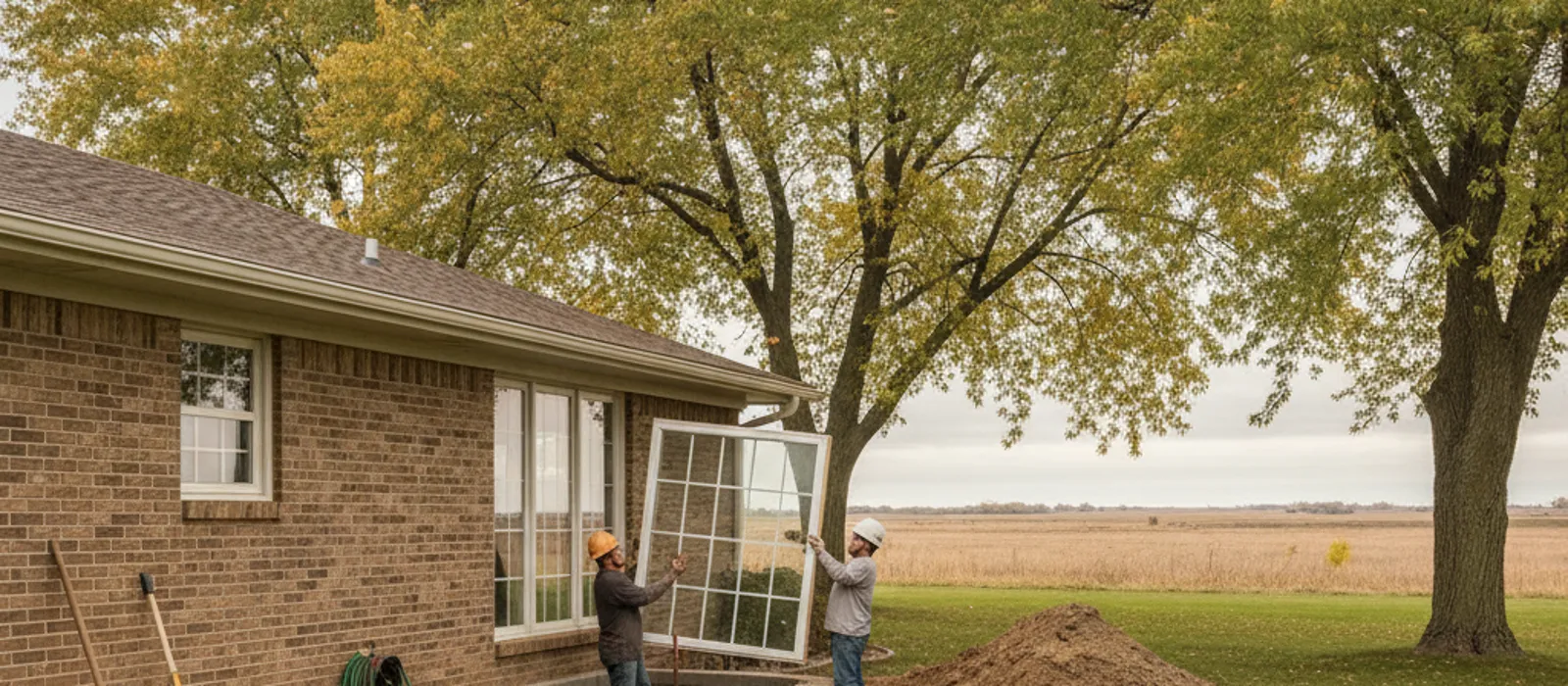
A buyer’s inspector walks into a finished Lincoln basement, points at a small sliding window above the bed, and says the room can’t legally be called a bedroom. That single sentence can knock thousands off an offer or kill a sale outright. The gap between an egress window vs basement window isn’t cosmetic; it’s the difference between a room the county will call a bedroom and one it won’t.
If you’re staring at a small basement window wondering whether it “counts,” you’re not alone. This is one of the most common questions we hear from homeowners across Lincoln, Waverly, Hickman, Seward, Crete, Beatrice, and Ashland. Below we’ll walk through exactly what separates the two, what Nebraska code requires, and what it actually costs to fix a window that doesn’t measure up.
If you already suspect your basement window won’t pass, skip ahead and get a free written estimate or call (402) 261-0485. It takes ten minutes to find out where you stand.
Egress Window vs Basement Window: What Each One Actually Is
A basement window is just that: a window. It lets in light, maybe cracks open a few inches for air, and does its job fine in a laundry room, storage area, or unfinished space where nobody sleeps. Most older Lincoln homes were built with small basement windows, often 20 to 30 inches wide and sitting high on the wall, sized for ventilation rather than escape.
An egress window is a specific, code-defined opening designed to let a person climb out in an emergency, and let a firefighter climb in. It has to meet minimum dimensions for width, height, and total clear opening area, sit at a maximum sill height above the floor, and open without tools or special knowledge. If the window is below grade, it also needs a window well sized to match.
Here’s the part that trips people up: not every window that looks big enough actually is. A window can appear roomy and still fail the “clear opening” math once you account for the sash, the frame, and how far it actually swings or slides open.
The distinction exists for a real reason, not just paperwork. Basements fill with smoke fast in a fire, and a window that’s too small, too high, or too hard to open can trap someone who could otherwise have climbed out. Code minimums for egress windows come directly from decades of fire safety data, which is also why the requirement gets enforced strictly during permitting and resale, not treated as a suggestion.
Side-by-Side Comparison: Egress Window vs Basement Window
| Feature | Standard Basement Window | Egress Window |
|---|---|---|
| Purpose | Light and ventilation | Emergency escape and rescue access |
| Minimum clear opening | None required | 5.7 sq ft (5.0 sq ft at grade floor) |
| Minimum opening width | None required | 20 inches |
| Minimum opening height | None required | 24 inches |
| Max sill height above floor | None required | 44 inches |
| Window well required (below grade) | No | Yes, minimum 9 sq ft floor area |
| Legal for use as a bedroom | No | Yes, when installed to code |
| Typical Lincoln cost | $400-$1,200 (swap only) | $1,200-$3,000 (replace in existing opening) to $3,500-$7,000 (new cut-in) |
These numbers come from the International Residential Code (IRC) Section R310, which Lincoln and Lancaster County use as the basis for local permitting. You can review the underlying code language through Lincoln-Lancaster County’s building and safety department if you want to see how it’s enforced locally.
Why a Standard Basement Window Won’t Cut It for a Bedroom
Nebraska code doesn’t care how nice the room looks. If you’ve got carpet, a closet, and a bed down there but the only window is a 24-inch-wide slider sitting 50 inches off the floor, that room is not a legal bedroom. Full stop. It might be a great den, office, or rec room, but it can’t be marketed, appraised, or rented as a bedroom.
This matters more than most homeowners expect. Appraisers count legal bedrooms when they set a home’s value. Landlords can face fines for renting out a “bedroom” that isn’t one. And in a real estate transaction, a sharp buyer’s agent or inspector will flag it every time, which is exactly what happened in the story above.
Dana Kowalski in Waverly ran into this firsthand. She’d finished her basement herself over two winters, complete with a bedroom for her teenage son, and only found out the window didn’t qualify when she called us to ask about adding a window well cover. We measured the opening: 22 inches wide, but the sill sat 48 inches above the finished floor, well over the 44-inch limit. She ended up doing a full cut-in install, a new opening cut lower and wider into the foundation, for $6,200, well within our typical $5,500-$9,500 range for a finished cut-in with well and interior trim work.
If you want to know exactly what counts as a legal bedroom under Nebraska rules before you finish a basement or list a house, read our breakdown on what counts as a legal bedroom in Nebraska. It’s worth five minutes before you swing a hammer.
Two Different Fixes: Window Swap vs. Full Egress Cut-In
Once you know a window doesn’t meet code, there are really two paths, and they cost very different amounts.
Basement window replacement (like-for-like swap). If the existing opening is already close to egress size, or you’re just replacing an old, foggy, or rotted basement window with a new non-egress unit, that’s a simple swap. In Lincoln, that typically runs $400-$1,200 depending on materials and whether the frame needs repair. This does not make the room a legal bedroom; it just gives you a newer window in the same rough opening.
Egress replacement or new cut-in. If the goal is code compliance, one of two things happens. Either the existing opening is close enough that a contractor can install a proper egress-rated window in it ($1,200-$3,000), or the foundation wall has to be cut wider and deeper to hit the minimum clear opening ($3,500-$7,000 for the cut-in alone). A full Lincoln job with a new window well, cover, and interior finishing commonly lands between $5,500 and $9,500. A Lincoln building permit for this kind of work typically runs $75-$200, and yes, you need one.
A few things push the price around within those ranges: soil type and how much excavation the well needs, whether there’s a porch, deck, or utility line in the way outside, wall thickness and material (poured concrete versus block cut differently), and whether you want a well cover, ladder, or drainage tie-in included. Window wells alone, replaced on their own without touching the window, run $600-$1,500 in most Lincoln jobs. Covers and ladders add another $150-$600 depending on size and material.
Marcus Tibbetts, who owns a rental duplex in Hickman, learned the hard way that a swap isn’t the same as compliance. He’d paid a handyman to replace a cracked basement window with a nicer vinyl unit for about $650, figuring that solved the “bedroom” issue his property manager flagged. It didn’t; the new window was the same undersized opening, just newer glass. He called us six months later after a tenant complaint, and we ended up doing a full cut-in at $5,900 to make the room legally rentable as a bedroom.
Not sure which category your situation falls into? Call (402) 261-0485 or send us photos and rough measurements through our contact page and we’ll tell you straight, no upsell, whether you need a swap or a cut-in.
Selling a House With a Non-Compliant Basement Bedroom
This is where the egress window vs basement window question gets expensive fast, and it’s not hypothetical. Carol Reyes in Seward was two weeks from listing her four-bedroom split-level when her realtor pointed out that the basement “fourth bedroom” had only a small awning window, no well, and a sill height nowhere near code. Advertising it as a four-bedroom house without fixing it would have been a fair housing and disclosure risk, and appraisers in the area routinely knock a bedroom off the count when they spot this.
Carol had us cut in a proper egress window and well for $5,800, finished about ten days before her listing photos went live. The house sold at asking price within a week, and her agent told her the egress window came up in two separate buyer walkthroughs as a reassuring detail, not a red flag.
If you’re weighing a sale, it’s worth reading our guide on selling a house with a non-compliant basement bedroom before you list. Fixing it ahead of time almost always beats negotiating a credit after an inspection kills your timeline.
DIY vs. Calling a Professional
Swapping a basement window in an existing, unchanged opening is a reasonable weekend project for a handy homeowner. Measure twice, buy the right size, caulk it properly, and you’re done.
A true egress conversion is a different animal. It usually means cutting concrete or block foundation wall, which affects the structural opening and can hit rebar or plumbing you can’t see from outside. It often involves excavation for a new window well, grading for drainage, and sometimes electrical work if there’s wiring routed near the well or a sump line close by. Get any of that wrong and you’re looking at water intrusion, a compromised foundation, or a well that traps rather than helps in an emergency.
Our advice, plainly: if the job requires cutting concrete, altering a load-bearing wall, or working near buried electrical or gas lines, stop and call a licensed contractor. It’s not a place to save money and hope for the best. For the code specifics that govern this kind of cut, our post on IRC egress window code requirements breaks down the technical side in plain language.
There’s also the permit and inspection side, which trips up plenty of DIYers in Ashland and Crete who assume nobody checks. Lincoln and Lancaster County require a permit for foundation cuts and window well installs, and the work gets inspected before it’s signed off. Skip the permit and you can run into trouble later at resale, when a title company or buyer’s inspector asks for the paperwork and there isn’t any.
We offer free written estimates and can usually tell you over the phone whether your project is a simple swap or a full cut-in before we ever step on your property. Reach out here or call (402) 261-0485, we run a 24/7 line for anyone facing an inspection deadline or a closing date that’s coming up fast.
Frequently Asked Questions
Can a basement window be turned into an egress window without cutting the foundation?
Sometimes. If the existing rough opening is already close to the 5.7 square foot clear opening requirement, a contractor can often install an egress-rated window and widen the well without cutting concrete. If the opening is more than a couple inches short on width or height, the foundation has to be cut, which is a bigger job.
Do all basement bedrooms in Nebraska legally need an egress window?
Yes. Any room used as a sleeping room, including basement bedrooms, needs a code-compliant egress opening under the IRC as adopted by Lincoln and Lancaster County. A finished basement room without one can be used as a den or office, but not marketed or appraised as a bedroom.
How much does it cost to fix a basement window that fails egress code?
In Lincoln, replacing an egress-rated window into an opening that’s already close to code runs $1,200-$3,000. A full cut-in, where the foundation opening has to be enlarged, typically runs $3,500-$7,000, or $5,500-$9,500 for a complete job with a new well and interior finishing.
Will a home inspector flag a basement window during a sale?
Almost always, if the basement has a bedroom without a compliant egress window. Inspectors and appraisers both check this, and it commonly shows up as a required repair item or a bedroom-count adjustment. Fixing it before listing usually costs less than negotiating a credit after the fact.
For general safety-room guidance during severe weather, which some Lincoln homeowners factor into egress and window well planning, the Ready.gov guide to safe rooms is a useful federal resource to cross-reference alongside your local code requirements.