
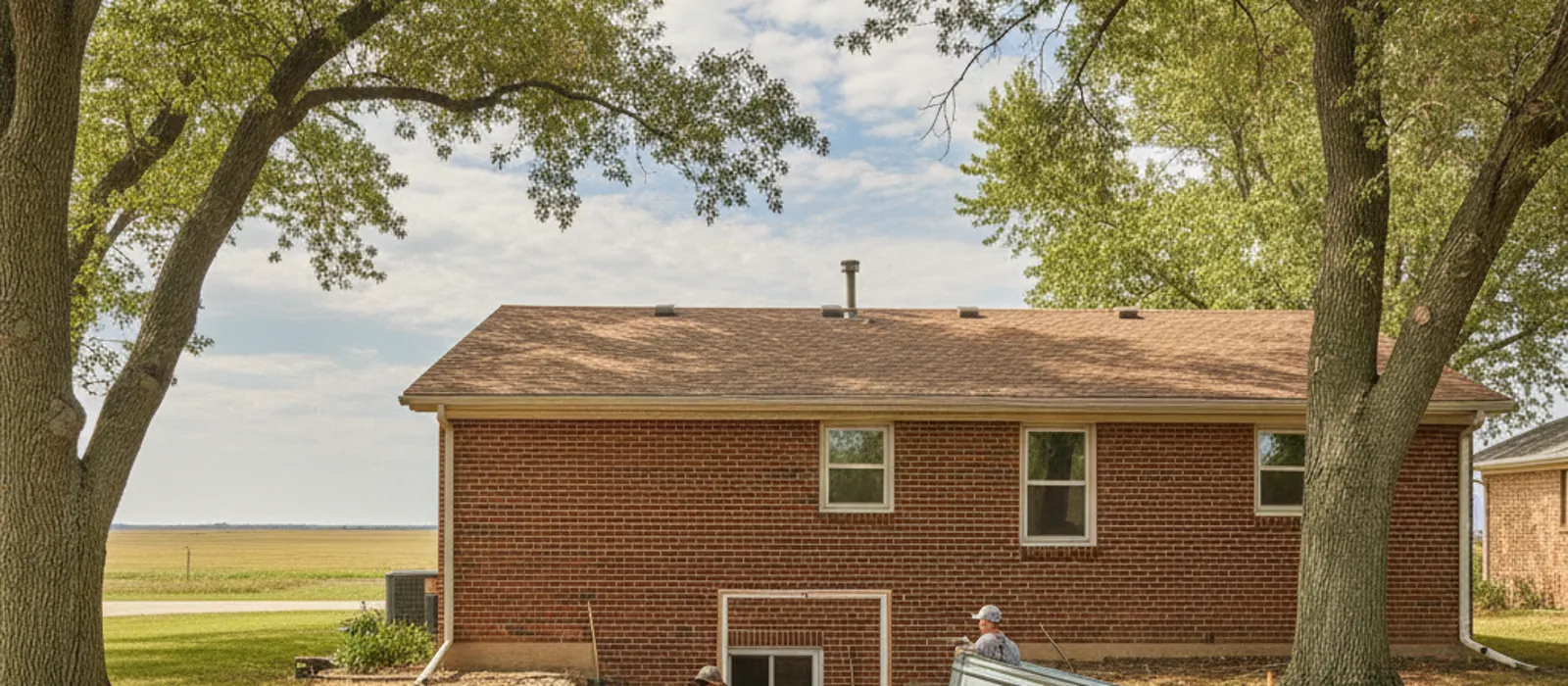
Your listing photos show four bedrooms, but the county only counts three. That gap between what your listing says and what your basement window actually allows is the single most common reason egress questions blow up a Lincoln home sale in the final two weeks.
If you’re selling a house with a non-compliant basement bedroom, you’re not alone and you’re not stuck. Buyers, agents, and appraisers in Lancaster, Seward, Saline, and Gage counties see this constantly, and there are a handful of clear paths through it. What matters is knowing which one fits your timeline and your budget before an inspector finds it for you.
Why a Non-Compliant Basement Bedroom Can Stall Your Sale
A basement bedroom without a proper egress window isn’t just a paperwork technicality. It’s a life-safety issue, and it’s the reason appraisers and lenders treat it differently than a room with a paint smell or an outdated light fixture.
When a bedroom lacks a code-sized escape window, three things tend to happen close together. The appraiser downgrades the bedroom count, which lowers the appraised value. The buyer’s lender may ask for the egress issue to be fixed as a condition of the loan. And your listing description, if it advertised “4 bedrooms,” now looks inaccurate to a buyer’s agent who did the math.
None of that means your sale falls apart. It means you need a plan, and the earlier you build one, the fewer surprises you’ll get at the closing table. If you want to talk through your specific basement and timeline, call (402) 261-0485 or reach out through our contact page before your first showing, not after your first offer.
What Actually Makes a Basement Bedroom Legal in Lincoln
Under the residential code Lincoln enforces, any room used as a sleeping room needs an approved means of escape and rescue, on top of a smoke detector and a minimum ceiling height. For a basement, that almost always means an egress window and, if the window sits below grade, a window well sized to match.
The City of Lincoln’s own building and safety guidance sets the minimum clear opening at 5.7 square feet, with a minimum opening height and width, and a sill no higher than 44 inches off the finished floor. Lincoln’s local standard is actually a bit stricter than the base international code’s 5.0 square foot minimum, which is why a basement bedroom that would pass in another state sometimes gets flagged here. You can see the city’s own egress window and well diagram on the City of Lincoln Building & Safety site if you want to check your own window’s rough dimensions before an inspector does.
A room can be “non-compliant” for more than one reason:
- The window opening is too small, even if a window well exists.
- There’s no window well at all, or the well is too shallow to let the window open fully.
- The window was never permitted, which shows up when a buyer’s title company or agent pulls permit history.
- The room lacks a second exit path and doesn’t meet ceiling height, in addition to the window problem.
If you’re not sure which category your basement falls into, our post on what counts as a legal bedroom in Nebraska walks through the full checklist room by room.
How It Shows Up at Inspection, Appraisal, and the Closing Table
Most sellers don’t find out about a non-compliant basement bedroom from a lawyer or an agent. They find out from a home inspector’s report, usually with a photo and a line item that says something like “basement bedroom window does not meet egress requirements.”
From there, one of three things typically happens. A cash buyer might not care and simply adjusts their offer down. A financed buyer’s lender may require the fix as a repair condition before closing, which puts you on a clock. Or the appraiser quietly recounts your home as a 3-bedroom instead of a 4-bedroom, which can shave real money off the appraised value regardless of what the buyer wants.
Kim Osterhaus in Waverly listed her raised ranch as a 4-bedroom in early spring. The appraiser, working off a tape measure and the city’s egress chart, ruled the basement window non-compliant and reappraised the home as a 3-bedroom, about $14,000 under the agreed price. Her buyer’s lender wouldn’t close without a fix. She called us on a Tuesday, and we cut in a proper egress window and matching well for $4,200. The appraisal was corrected and the sale closed only 11 days behind schedule.
Not every buyer requires a fix before closing, but every serious buyer will ask about it once an inspector flags it. That’s why the timing of your egress work matters as much as the work itself. Our page on what an egress window replacement or new cut-in installation actually costs breaks down pricing by scope, so you can price out the fix before you’re negotiating under deadline pressure.
Fix, Disclose, or Reprice: Your Options When Selling a House With a Non-Compliant Basement Bedroom
There’s no single right answer here. What’s right depends on your timeline, your equity, and how much friction you’re willing to negotiate through.
Option 1: Fix it before you list. This is the cleanest path if you have a few weeks of runway. A proper cut-in with a code-sized window and well typically runs $3,500 to $7,000 in Lincoln, or $5,500 to $9,500 once you add well finishing and interior trim work. You list with an honest 4-bedroom count, the appraisal supports it, and you avoid renegotiating with a nervous buyer mid-contract. Our egress window installation team handles the concrete cutting, well placement, and permit paperwork as one job, so you’re not coordinating three separate contractors on a deadline.
Option 2: Disclose it and price accordingly. Nebraska law requires sellers to complete a Seller Property Condition Disclosure Statement, and a non-compliant bedroom is exactly the kind of known defect that belongs on that form. You can read the state’s own guidance on the Nebraska Real Estate Commission’s disclosure information page. Pricing the home as a 3-bedroom with a bonus non-conforming room, rather than advertising a phantom 4th bedroom, tends to draw fewer walk-away buyers than getting caught mid-contract.
Option 3: Negotiate a credit or fix-at-close arrangement. Some buyers, especially cash buyers or investors, will accept a repair credit instead of requiring the work up front. This keeps your listing timeline intact but usually costs you more in the negotiation than doing the fix yourself would have, since buyers tend to overestimate repair costs.
Dave Wozniak in Hickman went with option two. He disclosed the basement bedroom’s window issue up front, listed the home priced as a 3-bedroom with a den, and took an offer $8,000 under what a compliant 4-bedroom would have fetched. It sold in nine days with zero renegotiation, which he preferred over gambling on a buyer accepting a fix-at-close deal.
If you’re weighing these options and want a same-day quote on what a fix would actually cost for your specific basement, call (402) 261-0485 or use our contact form. We do free written estimates, and knowing the real number often makes the fix-vs-disclose decision a lot easier.
What Fixing It Costs vs What Leaving It Non-Compliant Costs
Here’s how the numbers typically compare for a Lincoln-area seller weighing a pre-listing fix against selling as-is.
| Approach | Typical Cost | Effect on Sale |
|---|---|---|
| New egress cut-in + well (fix before listing) | $3,500-$7,000 (full quote $5,500-$9,500 with well and finishing) | Bedroom count holds up at appraisal; fewer contract surprises |
| Replace egress window in existing opening | $1,200-$3,000 | Fixes an undersized or failing window that already has a well |
| Window well only (add or replace) | $600-$1,500 | Needed if a compliant window exists but the well is missing or too shallow |
| Sell as-is, disclosed, priced as 3-bedroom | $0 upfront | Often $8,000-$15,000+ off asking price, based on local sales |
| Sell as-is, undisclosed | $0 upfront, high risk | Legal exposure, failed appraisals, buyer walkaways, possible post-sale claims |
The math tends to favor fixing it if you have any lead time before listing. A $4,000 to $9,000 investment against an $8,000 to $15,000 price hit isn’t a close call for most sellers, and it also removes the risk of a deal collapsing during underwriting.
Real Lincoln-Area Sales That Hinged on a Basement Bedroom
Renee Castillo, flipping a rambler in Beatrice, budgeted for a full egress cut-in before she ever listed the property. The window and well work ran $6,800 including the permit and interior finish. Because the home appraised cleanly as a true 4-bedroom, it sold above asking in eight days, and her buyer’s inspector had nothing to flag.
Compare that to a seller in Crete who skipped the fix and didn’t disclose the issue, assuming the inspector wouldn’t notice. The inspector noticed. The buyer’s lender required proof of a compliant egress window before the loan would fund, and the seller ended up paying for a rushed installation during an active under-contract period, at a premium over what a planned installation would have cost. Rush jobs under closing deadlines rarely come in cheaper.
The pattern holds across every town we work in, from Seward to Ashland: sellers who address a non-compliant basement bedroom early spend less and lose fewer buyers than sellers who wait for an inspector to find it.
Why You Shouldn’t DIY the Fix on a Deadline
Once you’re staring down a closing date, it’s tempting to save money by cutting the well opening yourself or having a handyman swap in a bigger window over a weekend. Resist that. A basement egress cut-in almost always means cutting through poured concrete foundation wall, and that’s not a job for a circular saw and good intentions.
Cutting foundation concrete without knowing where the rebar and load path run can weaken the wall, and getting it wrong is far more expensive to fix than the original job would have cost. If your basement has any electrical conduit or a panel near the proposed window location, that adds another layer where a mistake can be dangerous, not just costly. And in Lincoln, the work requires a permit ($75-$200) and an inspection, so a fix that isn’t pulled through proper channels can leave you with the exact same non-compliant status you started with, just with fresh drywall covering it up.
DIY is fine for cosmetic basement work: paint, trim, flooring around an existing compliant window. It’s not the place to save money on structural cutting, well drainage tie-ins, or anything within reach of a breaker panel. If a contractor quotes a same-day “fix” with no permit mentioned, that’s a red flag for a future buyer’s inspector to catch all over again.
Frequently Asked Questions
Do I legally have to fix a non-compliant basement bedroom before I sell?
No, Nebraska doesn’t require you to fix it before selling, but you do have to disclose known defects on the Seller Property Condition Disclosure Statement. Many buyers’ lenders will still require a fix as a loan condition, so “not legally required” doesn’t always mean “won’t come up.”
How much does it cost to bring a basement bedroom up to egress code in Lincoln?
A full new cut-in with a code-sized window and matching well typically runs $3,500 to $7,000, or $5,500 to $9,500 with well finishing and interior trim included. If a window well already exists and just the window is undersized, replacing it in the existing opening runs $1,200 to $3,000.
Will an appraiser really downgrade my home from 4 bedrooms to 3?
Yes, this happens regularly. Appraisers follow the same egress standards inspectors use, and a bedroom without a compliant escape window typically doesn’t count toward the bedroom total, which can lower the appraised value even if the buyer doesn’t personally mind the room.
Can I just call the basement room an office or den instead of a bedroom?
You can market it as a non-conforming bonus room, and many sellers do exactly that. Just make sure your listing description, MLS bedroom count, and disclosure form all match, since a closet and a bed in the photos will contradict a “den” label fast.
If you’re getting ready to list and want to know exactly where your basement bedroom stands, our home inspection egress window red flags post covers the specific things inspectors check, and our basement bedroom egress cost breakdown can help you budget before you talk to your agent. For a free written estimate on your specific window and well, call (402) 261-0485 or reach out through our contact page. We work throughout Lincoln, Waverly, Hickman, Seward, Crete, Beatrice, and Ashland, and we can usually get eyes on your basement within a few days, not weeks.