
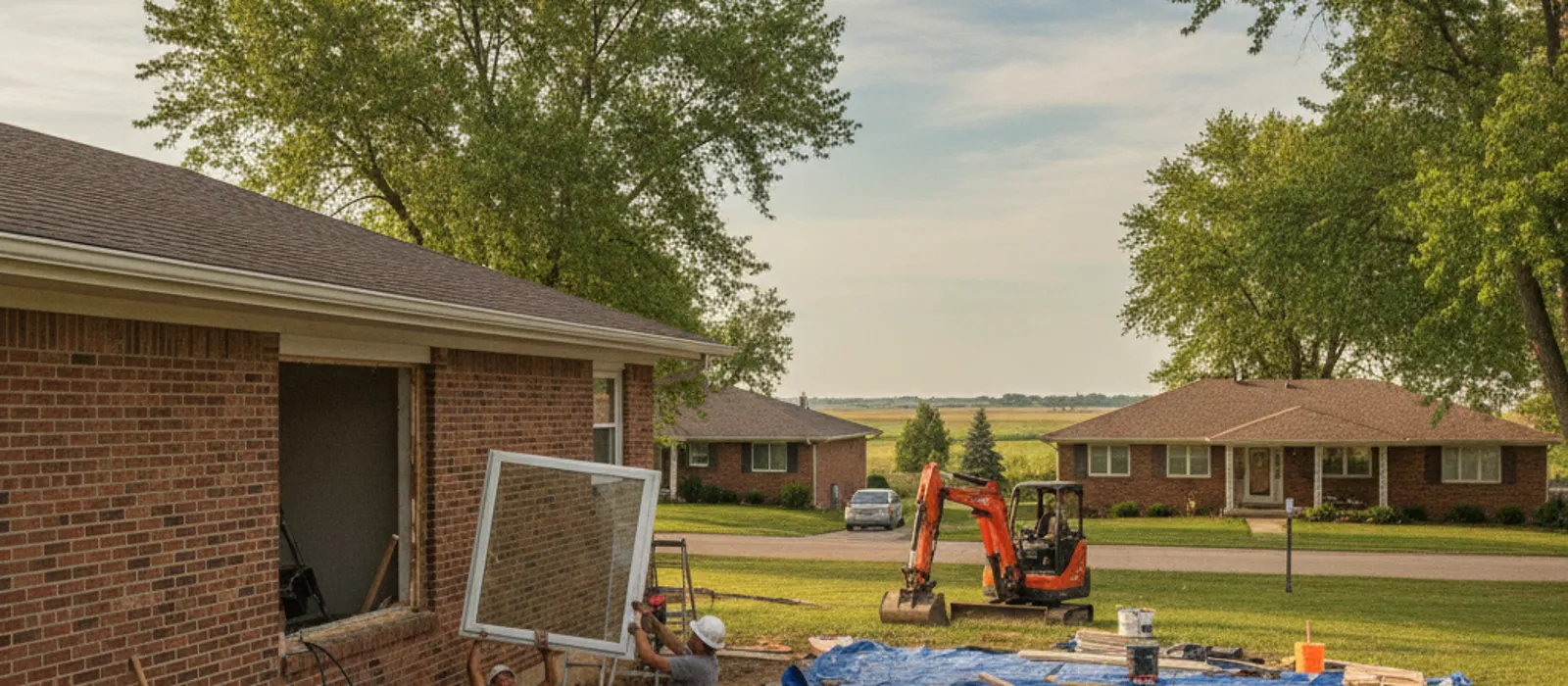
A Lincoln appraiser can knock a bedroom off your listing with one measuring tape and thirty seconds in your basement. No egress window, no legal bedroom, no matter how nice the carpet is or how many people have slept there.
If you’re trying to figure out what counts as a legal bedroom in Nebraska, the short answer is this: it needs a compliant escape window, enough ceiling height, enough floor space, and a smoke detector. Miss any one of those and the room is a “flex space” or a “den” on paper, even if it’s been the kid’s bedroom for ten years.
This matters more than most homeowners realize. It affects your home’s appraised value, what a lender will finance, what a buyer’s inspector will flag, and whether your rental property is legally habitable. Lincoln-Lancaster County inspectors and licensed appraisers use the same checklist, so there’s no gray area to hide in.
Below is the plain-language version of that checklist, plus what it actually costs to fix a room that doesn’t pass. If you already know your basement room is missing an egress window, you can get a free written estimate here before you read another word.
What Actually Counts as a Legal Bedroom in Nebraska
Lincoln and Lancaster County build their residential code off the International Residential Code, and Nebraska has formally adopted the 2018 IRC as its statewide baseline for one- and two-family homes. That code spells out four things a room needs before anyone, an appraiser, an inspector, or a real estate agent, can call it a bedroom.
- A code-compliant emergency escape window (egress window) or an exterior door.
- A minimum ceiling height, generally 7 feet over most of the room.
- A minimum floor area, generally at least 70 square feet with no dimension smaller than 7 feet.
- A working smoke detector, and in basements, often a carbon monoxide detector nearby.
Closets, walk-in storage, and stairwells don’t count toward that square footage. A finished basement room with a 6-foot ceiling under a duct or a room with only a small hopper window fails the test even if it has a bed, a dresser, and a door.
Call our office at (402) 261-0485 if you want a straight answer on whether your specific room qualifies. We measure it in person and tell you exactly what’s missing, no upsell required.
The Egress Window Rule: Nebraska’s Non-Negotiable Requirement
Of the four requirements above, the egress window is the one that trips up the most Lincoln homeowners, because it’s the one that’s expensive to fix after the fact.
Under the code Lincoln enforces, every sleeping room, and every basement that contains a sleeping room, needs its own operable emergency escape and rescue opening. That window has to meet specific numbers, not just “look big enough”:
- Net clear opening of at least 5.7 square feet (5.0 square feet is allowed for ground-floor openings).
- Minimum clear width of 20 inches.
- Minimum clear height of 24 inches.
- Sill height no more than 44 inches above the finished floor.
- If the window is below grade, it needs a window well with at least 9 square feet of horizontal area and a projection of at least 36 inches from the foundation, plus a permanently fixed ladder if the well is deeper than 44 inches.
It has to open from the inside without a key, a tool, or any special knowledge, because the entire point is a firefighter or a scared eight-year-old can get through it in the dark. A window that’s painted shut or has a security bar bolted over it doesn’t count as egress no matter how big the glass is.
You can see the exact dimensions the county checks on the Lincoln-Lancaster County egress window and well detail sheet, which is the same drawing our crews build to on every job.
Ceiling Height, Room Size, and the Other Boxes a Bedroom Has to Check
Egress gets all the attention, but it’s not the only thing that turns a room into a legal bedroom. We still see Lincoln basements that pass on the window and fail on everything else.
Ceiling height matters because the code wants at least 7 feet of clearance over the required floor area of a habitable room, though most versions of the code allow local dips down to 6 foot 4 inches under beams, ducts, or soffits as long as they don’t cover the whole room. A basement with ductwork run low across the middle, common in older Lincoln and Waverly homes built before central air was standard, can lose its bedroom status over six inches of clearance.
Floor area matters too. The room needs roughly 70 square feet of clear space with no wall shorter than 7 feet. A converted storage nook or a sliver of basement behind the furnace usually can’t hit that number no matter what you put in it.
And the room needs a smoke alarm, wired or interconnected in most new work, plus a carbon monoxide detector nearby if there’s any fuel-burning appliance on that level, which describes most Lincoln basements with a furnace or water heater.
What Counts as a Legal Bedroom in Nebraska When You’re Selling
This is where the code stops being an abstract rulebook and starts costing or saving you real money.
Denise, a homeowner in Waverly, listed her house last spring with the basement’s third bedroom included in the square footage and the asking price. The buyer’s inspector found a 30-inch-wide window with a 30-inch sill height, non-compliant on both width and height, and flagged it in the report. Her agent had to pull the bedroom count from the listing mid-contract, and the buyer’s lender recalculated the appraisal without it. Denise ended up negotiating $4,800 off the sale price to cover a proper egress retrofit instead of paying full price for the fix herself before closing.
That’s the pattern we see over and over. Appraisers use bedroom count as one of the biggest levers in comparable-sales value, and they won’t count a room without a compliant escape window. A “4-bedroom” house that’s really a legal 3-bedroom can lose tens of thousands in appraised value, not just the cost of the window.
If you’re getting ready to list, it’s worth a quick professional check before a buyer’s inspector finds the problem for you. Related reading: what happens when you try to sell a house with a non-compliant basement bedroom and our breakdown of the Lincoln-Lancaster County egress permit process.
What It Costs to Turn a Basement Room Into a Legal Bedroom
Costs vary a lot depending on whether you’re replacing an undersized window in an existing opening or cutting a brand-new opening through poured concrete.
| Project | Typical Lincoln-area cost | When you need it |
|---|---|---|
| Window well replacement (rusted or collapsed) | $600 - $1,500 | Well is failing but the window itself is compliant |
| Egress window replacement in existing opening | $1,200 - $3,000 | Opening is already the right size, window or well isn’t |
| New egress cut-in (concrete cutting, new opening) | $3,500 - $7,000 | No opening exists yet or the existing one is too small |
| Full Lincoln install with new well and interior finishing | $5,500 - $9,500 | Turning an unfinished area into a legal bedroom |
| Basement window swap (non-bedroom window) | $400 - $1,200 | Room isn’t used as a bedroom, just needs a working window |
| Lincoln-Lancaster County building permit | $75 - $200 | Any egress cut-in or window well install |
| Window well cover or ladder | $150 - $600 | Safety and code compliance for existing wells |
Marcus and his wife in Hickman finished their basement themselves over a winter, framing a bedroom for their teenage son around an old 24-inch hopper window. When they applied for their final permit sign-off, the county wouldn’t approve the sleeping room because the sill height sat at 48 inches, four inches over the limit, and the net clear opening came up short. They ended up paying $6,200 for a full cut-in with a new well and ladder, on top of the framing work they’d already done. Getting the egress right before finishing the room would have saved them from redoing drywall around the new opening.
See our full egress window cost guide for a deeper breakdown by home type and foundation, and check out egress window size requirements for Nebraska homes if you’re not sure your current window is close.
Permits, Inspections, and When to Call a Pro
Every egress cut-in or window well install in Lincoln and Lancaster County needs a permit and an inspection, generally $75-$200 for the permit itself. Skipping it isn’t a shortcut. An uninspected egress window shows up as a red flag on a future home inspection or appraisal just like a missing one does, and you can’t legally claim the room as a bedroom without the sign-off in the county’s records.
This is also where we tell homeowners to stop doing it themselves. Cutting through a poured concrete foundation wall requires knowing where the rebar and load-bearing points are, and getting it wrong can crack the foundation or compromise the wall. Any work near underground electrical or gas lines around the window well area needs a locate call and, often, a licensed hand. DIY is fine for painting trim or adding a window well cover. It’s not the place to save money on structural cutting or anything involving utilities.
In Crete, a landlord named Roger was renting out a three-bedroom house where the basement bedroom’s window well had partially collapsed, burying the escape route in dirt. He tried to fix it himself with retaining wall blocks from a home store, and it failed inspection twice before he called a licensed crew to install a proper well to code, roughly $1,100 with the new cover. He’d been renting the unit as a “3-bedroom” for two years without a legal third bedroom, which is a liability most landlords don’t want to think about until a tenant asks.
Ready to find out where your room stands? Request your free written estimate or call (402) 261-0485 and we’ll walk you through exactly what your home needs, no pressure, no guesswork.
Frequently Asked Questions
Does every bedroom in Nebraska legally need its own egress window?
Yes. Every sleeping room, on any level, needs its own operable emergency escape and rescue opening, and a basement needs one in each room used as a bedroom even if the basement also has a separate exterior door. One egress window can’t cover two bedrooms.
Can a basement room be a “legal bedroom” without a closet?
Yes, most versions of the code Lincoln enforces don’t require a closet for a room to count as a bedroom. What they do require is the egress window, minimum ceiling height, minimum floor area, and a smoke detector. A closet is a real estate convention, not a code requirement.
How do I know if my current basement window is close enough to pass?
Measure the clear opening width and height with the window fully open, not the frame size, and measure the sill height from the finished floor. If you’re under 5.7 square feet of net clear opening, under 20 inches wide, under 24 inches tall, or over 44 inches off the floor, it won’t pass. Our egress window size guide for Nebraska homes walks through how to measure it yourself.
Will fixing a non-compliant bedroom actually increase my home’s value?
In most cases, yes, because appraisers count legal bedrooms directly in their valuation model and buyers search by bedroom count. A $5,500-$9,500 cut-in that legally adds a bedroom to a Lincoln listing often returns more than that in appraised value, especially compared to losing a bedroom count during a sale like Denise did in Waverly.