
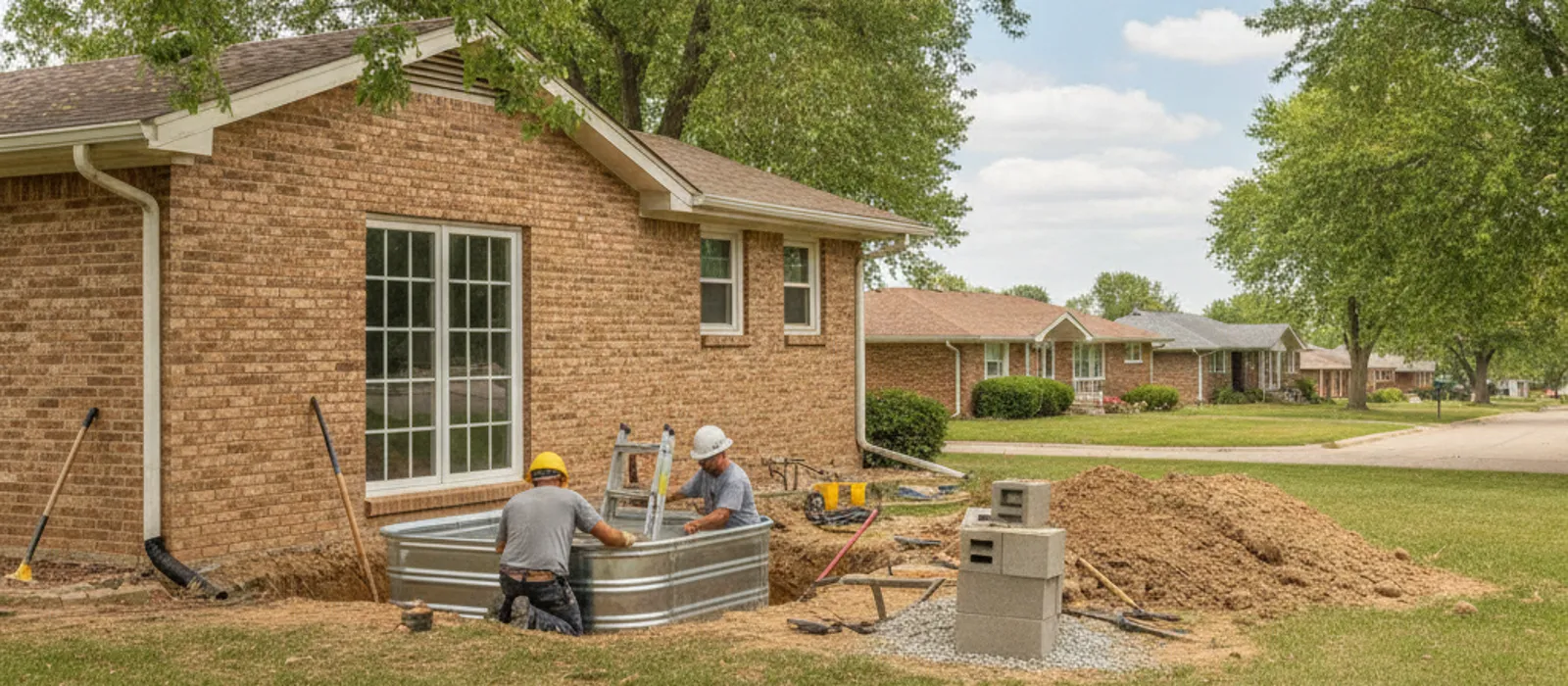
A Lincoln home inspector failed a basement bedroom last spring, and it wasn’t the window or the well that killed the deal. It was a missing ladder.
If your window well is deeper than 44 inches, code doesn’t care how nice the window looks or how big the well is. Window well ladder requirements kick in automatically, and skipping them is one of the most common reasons Lancaster County inspections stall or home sales stumble right before closing.
The good news is that the rules aren’t complicated once someone walks you through them. This guide covers what the International Residential Code requires for window well ladders, what inspectors in Lincoln and the surrounding counties actually look for, and what it costs to fix a well that’s missing one. If you’re not sure your well qualifies, call Lincoln Egress Windows at (402) 261-0485 for a free look before a buyer’s inspector finds the problem first.
Why Window Well Ladder Requirements Exist (Not Just a Suggestion)
Egress windows exist for one reason: to give someone in a basement bedroom a way out during a fire or other emergency. A window that opens is only half the job. If the well outside it is too deep to climb out of, the window doesn’t do much good.
That’s the whole logic behind window well ladder requirements. Once a well is deep enough that an adult or child can’t simply step out of it, code requires a permanent way to climb. It’s not about making the well look finished. It’s about making sure the exit actually works when someone needs it in the dark, in a panic, without time to think.
Home inspectors, appraisers, and Lancaster County building staff all check for this because a basement bedroom without a code-compliant well and ladder isn’t legally a bedroom. That affects safety first, but it also affects what the room is worth on paper.
The IRC Window Well Ladder Requirements, Plain and Simple
The International Residential Code, adopted throughout Lincoln and most of Southeast Nebraska, spells this out in section R310.2.3. Here’s the short version:
- Any window well deeper than 44 inches, measured from the bottom of the well to the ground surface outside it, needs a permanently attached ladder or steps.
- The ladder or steps must be usable with the window in the full-open position. A ladder that blocks the window when it swings open doesn’t count.
- Rungs or steps can’t project more than 6 inches into the required horizontal area of the well.
- The ladder must be at least 12 inches wide.
- Rungs need to be spaced no more than 18 inches apart vertically, and they have to reach the top of the well.
- Materials have to resist corrosion, since the ladder sits outside, in soil and moisture, year-round.
None of this is unique to Nebraska. It’s a national code baseline, and Lincoln’s building department enforces it the same way most cities do. You can review the city’s adopted codes and permit requirements directly through the Lincoln-Lancaster County Building and Safety Department.
What Counts as a Compliant Ladder (Materials, Rungs, and Spacing)
Not every ladder bolted onto a window well liner passes inspection. Inspectors check three things most often: spacing, projection, and how it’s attached.
Spacing matters because rungs set too far apart make the ladder useless for kids, older adults, or anyone climbing out fast. The 18-inch maximum isn’t arbitrary. It’s close to a normal step height, so the ladder actually functions like stairs rather than a stretch-and-hope climb.
Projection matters because a ladder that eats too much of the well’s width narrows the space someone needs to physically get out. A ladder mounted correctly leaves the rest of the well clear.
Attachment is where DIY jobs usually go wrong. A ladder has to be permanently fixed to the well wall or the foundation, not just resting against the liner or held on with a couple of screws into corrugated steel. Corrugated and polyethylene wells both flex slightly with frost and moisture, so the anchoring needs to account for that movement over a Nebraska winter. Prefabricated code-compliant ladders and covers generally run $150 to $600 installed, depending on well depth and material.
Ladder vs. Steps: Two Ways to Meet Window Well Ladder Requirements
Code gives homeowners two paths to compliance. Both show up in the same section of the IRC, and both get inspected the same way.
| Feature | Fixed Ladder | Built-In Steps |
|---|---|---|
| Best for | Narrower or retrofit wells | Wider wells with room to spare |
| Typical material | Galvanized or powder-coated steel | Poured concrete, steel, or precast blocks |
| Installation | Bolts to well wall, faster retrofit | Usually built during well installation |
| Approximate cost | $150-$600 | Often included in a $600-$1,500 well replacement |
| Maintenance | Check anchors yearly for rust or loosening | Very low; steps rarely shift |
Most retrofits in existing homes use a fixed ladder because it’s faster and cheaper than rebuilding the well. New construction or full well replacements sometimes build steps in from the start, especially on deeper wells.
Real Stories From Southeast Nebraska Wells
Hickman. A seller named Dana had a signed contract and a closing date nine days out when the buyer’s inspector flagged a 52-inch well with no ladder at all. The basement bedroom was part of the listed square footage, so the deal was at risk. Lincoln Egress Windows got a corrosion-resistant ladder anchored and inspected within four days, for $380, and the sale closed on schedule.
Waverly. A homeowner named Tom tried to save money by screwing a hardware-store ladder into the well liner himself. It looked fine until the county inspector pushed on it during a routine permit check for an unrelated project. The ladder wasn’t anchored into the foundation wall, just the thin liner, and it failed on the spot. Redoing it properly with wall anchors cost $450, on top of the ladder Tom had already bought.
Beatrice. A landlord named Priya was preparing a rental property for a city rental license inspection. Two of her basement units had window wells with no ladders and cracked covers. Adding compliant ladders and new covers to both wells ran $520 total, and it cleared the rental inspection without a follow-up visit.
If any of that sounds familiar, don’t wait for an inspector to find it. Reach out through our contact form or call (402) 261-0485 and we’ll tell you plainly whether your well needs a ladder, steps, or nothing at all.
Installing or Retrofitting a Ladder the Right Way
Getting this right isn’t complicated, but it does take a few deliberate steps.
First, measure the actual depth of the well from the ground surface to the well floor. Wells right around the 44-inch line get measured wrong more often than people expect, and a half-inch either way changes what’s required.
Second, match the ladder to the well material. Corrugated steel wells, polyethylene wells, and poured concrete wells each need different anchoring hardware. A ladder rated for concrete won’t hold the same way in a plastic liner.
Third, anchor into something solid, ideally the foundation wall itself, not just the well shell. This is the step most DIY jobs skip, and it’s the one inspectors check first.
Fourth, confirm the window still opens fully with the ladder in place. Test it before calling the job done, not after.
A full window well installation with a compliant ladder built in typically runs $3,500 to $7,000 for a new cut-in, or $600 to $1,500 for a standalone well replacement on an existing opening. Lincoln building permits for well and egress work generally run $75 to $200. If you’re planning a new well or a full egress window installation rather than a ladder retrofit, our window well installation and egress window installation pages walk through what’s involved and what it costs in more detail.
When to Call a Professional Instead of DIY-ing It
A ladder retrofit on an existing, healthy well is a reasonable DIY project for someone comfortable with basic tools and anchoring hardware. Plenty of homeowners handle it themselves without issue.
Stop and call a contractor if any of the following apply. The well wall is cracked, bowing, or pulling away from the foundation, since anchoring a ladder into damaged concrete or steel isn’t safe no matter how well the ladder itself is installed. There’s exterior lighting or wiring running near or through the well, since drilling blind near electrical lines is not a DIY risk worth taking. The window itself needs to be enlarged or the opening needs to be cut into the foundation, since that’s structural work that requires a permit and a licensed contractor regardless of the ladder question.
For general guidance on ladder rung spacing and safe climbing angles that applies beyond just window wells, the OSHA portable ladder standards are a useful reference point, even though they’re written for job sites rather than residential egress code.
When in doubt, get a second opinion before a buyer’s inspector or a county inspector makes the call for you. A quick site visit costs nothing and can save a closing date. You can also read more about what inspectors flag in our post on home inspection egress window red flags, or check the full code list in our breakdown of IRC egress window code requirements.
Frequently Asked Questions
How deep does a window well have to be before it needs a ladder?
Under the IRC, any window well deeper than 44 inches from the ground surface to the well floor needs a permanently attached ladder or built-in steps. Wells shallower than that don’t require one, since a person can typically step out unassisted. It’s worth measuring carefully, since wells close to the 44-inch line are the ones most often missed during a quick visual check.
Can I use a portable or leaning ladder instead of a fixed one?
No. Code requires the ladder to be permanently affixed to the well wall or foundation, not a portable ladder that could shift, fall, or get removed. A leaning or unsecured ladder will fail inspection every time, even if the well itself is otherwise compliant. It also isn’t reliable in an actual emergency, which defeats the purpose of egress code in the first place.
Do window well ladders need a permit in Lincoln?
A standalone ladder retrofit on an existing, undamaged well usually doesn’t require a separate permit, but a full well installation or replacement typically does. Lincoln permits for well and egress work generally run $75 to $200. If you’re unsure whether your specific project needs one, our team or the city building department can confirm before work starts.
What happens if my window well doesn’t meet ladder requirements during a home sale?
It usually shows up on the buyer’s inspection report and either delays closing or gets negotiated as a repair credit. Since a non-compliant well can affect whether a basement room legally counts as a bedroom, it can also affect the home’s appraised value. Fixing it before listing, rather than after an inspection flags it, almost always costs less and moves faster. Related reading on that topic is in our post on selling a house with a non-compliant basement bedroom.
Window well ladder requirements aren’t complicated once you know the numbers: 44 inches triggers the rule, 18-inch rung spacing, 12-inch minimum width, and permanent anchoring. Whether you’re fixing a well before a sale, finishing a basement, or just noticed your ladder looks shaky, Lincoln Egress Windows can check it and give you a straight answer. Call (402) 261-0485 or contact us for a free written estimate.