
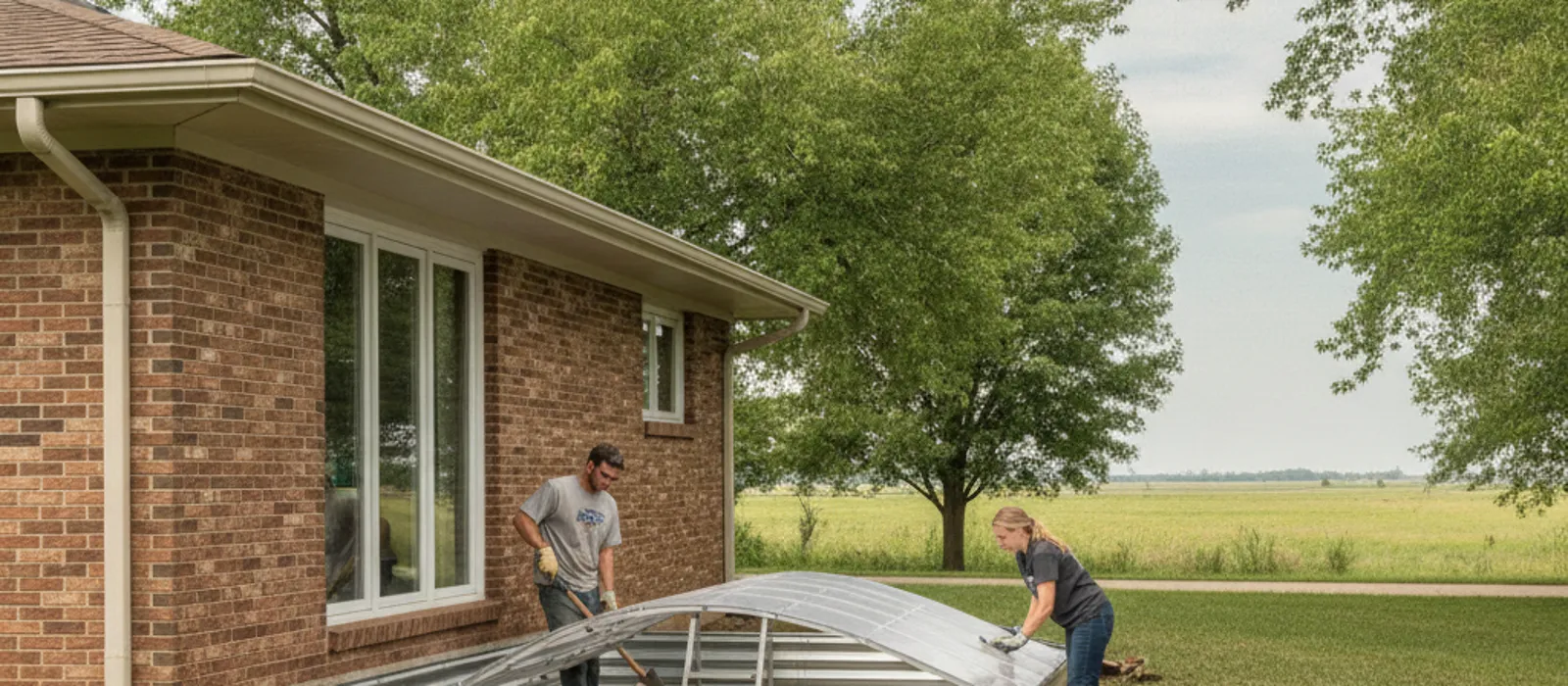
Stand in your basement and look up at that window. Can you see the ground outside, or does the glass sit below the dirt line with nothing but a wall of soil behind it? If it’s the second one, you’re probably asking the right question: do I need a window well?
The short answer is yes, if that window sits below grade and it’s supposed to serve as an emergency exit or meet code for a bedroom. Here’s how to know for sure, what it costs to fix, and what happens if you skip it.
We get this question year-round from homeowners across Lincoln, Waverly, Hickman, Seward, Crete, Beatrice, and Ashland. Sometimes it comes up because a basement finishing project is underway. Sometimes it’s a home inspector’s report that mentions “non-conforming bedroom” and nobody explained what that means. Either way, the fix is usually more straightforward than people expect once they know what to look for.
How to Tell If You Need a Window Well
A window well is the metal, plastic, or concrete enclosure that holds back dirt around a basement window so the window can open fully to the outside. Without one, a below-grade window is just staring into packed soil. It can’t function as an exit no matter how big the glass is.
You likely need a window well if any of these are true:
- Your basement window sits at or below ground level and opens against dirt.
- You’re finishing a basement room you plan to use as a bedroom.
- A home inspector or appraiser flagged the room as “non-conforming” for sleeping use.
- You’re selling a house with a basement bedroom that has no exterior exit.
- Your existing well is rusted through, caving in, or too small for the window it surrounds.
If none of those apply and your basement window sits above grade with open sight lines to the yard, you probably don’t need one. But if you’re planning to add a bedroom, home office, or rental unit below grade in Lincoln, Waverly, Hickman, Seward, Crete, Beatrice, or Ashland, get it checked before you frame a single wall. Our window well installation service starts with a walkthrough, not a sales pitch. Call us at (402) 261-0485 or request a free written estimate and we’ll tell you straight whether your window needs a well, a full egress swap, or nothing at all.
One more wrinkle worth knowing: even if your window currently has a well, that doesn’t automatically mean it’s compliant. Older wells built before current code adoption are sometimes too shallow, too narrow, or missing the projection needed for the window to fully open. A tape measure and five minutes will tell you more than guessing.
What Nebraska Code Actually Requires for a Basement Bedroom
The International Residential Code, adopted across most of Nebraska including Lincoln and Lancaster County, is clear on this point. Every sleeping room, including a basement bedroom, needs an emergency escape and rescue opening. If that opening’s sill sits below ground level, the code requires a window well sized to let the window open fully and let a person climb out.
That’s not a suggestion. It’s the rule an inspector checks before signing off on a finished basement, and it’s the rule a real estate agent’s contractor checks before listing your house as having a “3-bedroom” instead of a “2-bedroom plus office.” Lincoln’s Building and Safety Department publishes a typical egress window and well detail that spells out minimum well dimensions, and you’ll need a permit (typically $75 to $200 in Lincoln) before work starts.
Minimum specs worth knowing:
- The window opening needs at least 5.7 square feet of clear opening (5.0 square feet on grade-floor windows).
- The sill height can’t be more than 44 inches above the finished floor.
- A window well deeper than 44 inches needs a permanent ladder or steps.
- The well itself needs enough horizontal projection, generally 36 inches, for the window to swing or slide open completely.
Read more on the full standard in our post on IRC egress window code requirements. If you’re buying or selling, it’s worth checking with your agent whether a basement bedroom without a compliant exit is being marketed correctly, since that gap tends to surface during inspection either way.
The permit and inspection process itself is fairly quick once the project is scoped correctly. Lincoln-Lancaster County typically reviews and issues a residential egress permit within a few business days, and the final inspection happens after the well and window are installed, before you close up drywall around it. Skipping the permit to save time is one of the most common mistakes we see, and it almost always costs more later when a buyer’s inspector or appraiser catches an unpermitted opening.
Egress Window vs. Basement Window: They’re Not the Same Thing
This is where a lot of homeowners get tripped up. A basement window lets light in. An egress window is a specific, code-rated opening built to let a person out during a fire or emergency, with minimum size, sill height, and well requirements attached.
You can have a basement window that looks fine and still fails code as an egress opening, because it’s too small, too high off the floor, or missing a well entirely. Swapping the glass for a bigger pane doesn’t fix that if the surrounding frame and opening don’t meet the dimensions. For a full breakdown, see our post comparing an egress window vs. a basement window. Our egress window installation crews handle both the well and the cut-in when a basement window needs to be upgraded to a true egress opening.
This distinction matters most at resale. A basement room with a bed in it but no egress window is, on paper, not a legal bedroom no matter what the listing says. Appraisers and lenders both check for it, and a room that gets reclassified from “bedroom” to “flex space” during an appraisal can shave real dollars off your sale price. It’s a cheap fix compared to what it costs you at the closing table.
Mini example: In Hickman, a homeowner named Dana was finishing her basement into a guest bedroom for her mother-in-law. She figured the existing 24-inch basement window was close enough. Our crew measured it: the clear opening came in under 4 square feet, well short of code. Cutting a proper egress opening and installing a new well ran $6,200 total. Skipping it would have meant an unpermitted bedroom that couldn’t legally be called one, and a headache at resale.
Signs Your Existing Window Well Isn’t Doing Its Job
Maybe you already have a window well, but something’s off. Watch for these signs that it needs repair or full replacement rather than a patch:
- Rust holes or bowing walls. Corrugated steel wells last a couple decades in Nebraska’s freeze-thaw cycles before rust eats through. Once you see holes or the wall bulging inward from soil pressure, it’s failing.
- Standing water after rain. A well without working drainage turns into a small pond, which can leak into your basement and rot the window frame. A properly built well ties into a gravel base and drain line so water moves away from the foundation instead of sitting against it.
- Cracked or missing cover. An open or broken cover is a fall and drowning hazard, especially for kids and pets. The Consumer Product Safety Commission lists uncovered wells and similar backyard openings among common in-home drowning risks worth eliminating, a point covered in its in-home drowning safety guidance.
- Gaps between the well and the foundation. Settling soil can pull a well away from the house, leaving a channel for water straight into your basement wall.
Mini example: In Crete, a couple named Mike and Rosa had a 1980s corrugated steel well that had rusted almost all the way through on one side. After a heavy spring rain, water pooled in the well and seeped past the window seal, soaking their carpet. Replacing the well with a polyethylene unit and resealing the window cost $1,150 and solved the leak for good.
What It Costs to Add or Replace a Window Well in Lincoln
Costs vary based on whether you’re patching an existing well, replacing it, or cutting a brand-new egress opening where none existed. Here’s what we typically see across Lincoln and the surrounding towns.
| Project | Typical Cost | What’s Included |
|---|---|---|
| Window well replacement only | $600-$1,500 | New well, backfill, basic drainage tie-in |
| Egress window replacement in existing opening | $1,200-$3,000 | New window, reuse of opening, sealing |
| New egress cut-in with well (full install) | $3,500-$7,000 | Concrete cutting, new opening, window, well |
| Full Lincoln project with well and finishing | $5,500-$9,500 | Cut-in, window, well, interior trim work |
| Basement window swap (no well needed) | $400-$1,200 | Window only, above-grade or existing opening |
| Well cover or ladder add-on | $150-$600 | Safety cover, drainage grate, or steel ladder |
For a deeper dive into what drives these numbers up or down, read our window well installation cost breakdown. If a new opening isn’t in your budget yet, ask us about financing when you call. Most Lincoln projects can be spread into monthly payments rather than paid in one lump sum.
A few things push a project toward the higher end of these ranges: foundation wall thickness, how deep the well needs to sit, whether you want a polycarbonate cover or ladder added, and how much interior trim and drywall repair the cut-in requires. A shallow well on a standard 8-inch foundation wall runs cheaper than a deep well cut through a thicker or reinforced wall.
Need a number specific to your house? Get a free written estimate before you commit to anything. We’ll walk your basement, measure the actual opening, and tell you what it takes to make it legal.
DIY Checks vs. When to Call a Professional
You can do some of this homework yourself before ever picking up the phone. Measure the window opening with a tape measure. Check the sill height off the finished floor. Look at the well for rust, cracks, or standing water. Snap a few photos. If you’re comparing quotes from different contractors, ask each one for a written scope, a permit plan, and proof of license and insurance before you sign anything.
What you should not do yourself:
- Cutting concrete for a new opening. This involves structural load-bearing walls, and getting it wrong risks foundation damage.
- Digging a well next to utility lines. Nebraska requires a call to 811 before any digging, and window wells often sit near buried electrical, gas, or water lines.
- Working near electrical panels or outlets close to the well. Water and electricity near an excavation is a serious hazard.
- Pulling a permit yourself if you’re not the general contractor of record. Lincoln-Lancaster County requires the work to match the permit, and DIY egress cuts are one of the most common reasons a home inspection flags an issue at resale.
Mini example: A Beatrice homeowner named the Petersons tried to save money by digging their own window well before calling us for the window install. They hit a buried gas line marker they hadn’t seen and had to stop the job, call the utility company, and wait two days before work could resume. Between the delay and re-grading the yard afterward, it added about $400 to a project that would have cost less if they’d called a licensed contractor from the start.
If your project involves anything beyond swapping a window in an existing, correctly sized opening, get a professional opinion first. Our crews are licensed and insured, and every estimate is free and in writing, including after-hours calls if you’re up against a closing deadline.
Frequently Asked Questions
How do I know if my basement window needs a well?
If the window sits at or below ground level with dirt directly behind the glass, it needs a well to open fully and function as an exit. Measure the opening and sill height, then compare them to Nebraska’s IRC minimums. If you’re unsure, a quick site visit from a licensed installer will settle it.
Can I skip the window well if I’m not using the room as a bedroom?
Possibly, but only if the room isn’t classified as a sleeping room and you’re not planning to sell it as one. Home offices, storage, and rec rooms without egress windows are usually fine. The moment a bed goes in, code and resale value both expect a compliant exit.
How much does a window well cost in Lincoln, NE?
A standalone well replacement runs $600 to $1,500. A full new egress cut-in with a well typically lands between $5,500 and $9,500 once you include the window, concrete cutting, and finishing work. Get a free written estimate for a number specific to your house.
What happens if I sell my house with a basement bedroom that has no window well?
Inspectors and appraisers will typically flag it as a non-conforming bedroom, which can lower your listed bedroom count and your sale price. Buyers’ lenders sometimes require the fix before closing. Handling it ahead of listing avoids a scramble against a closing deadline.
Whether you’re finishing a basement in Ashland, prepping a house to sell in Seward, or just fixing a rusted-out well in Lincoln, the fastest way to get a straight answer is a free, no-pressure estimate. Reach out here or call (402) 261-0485 and we’ll tell you exactly what your window needs.