
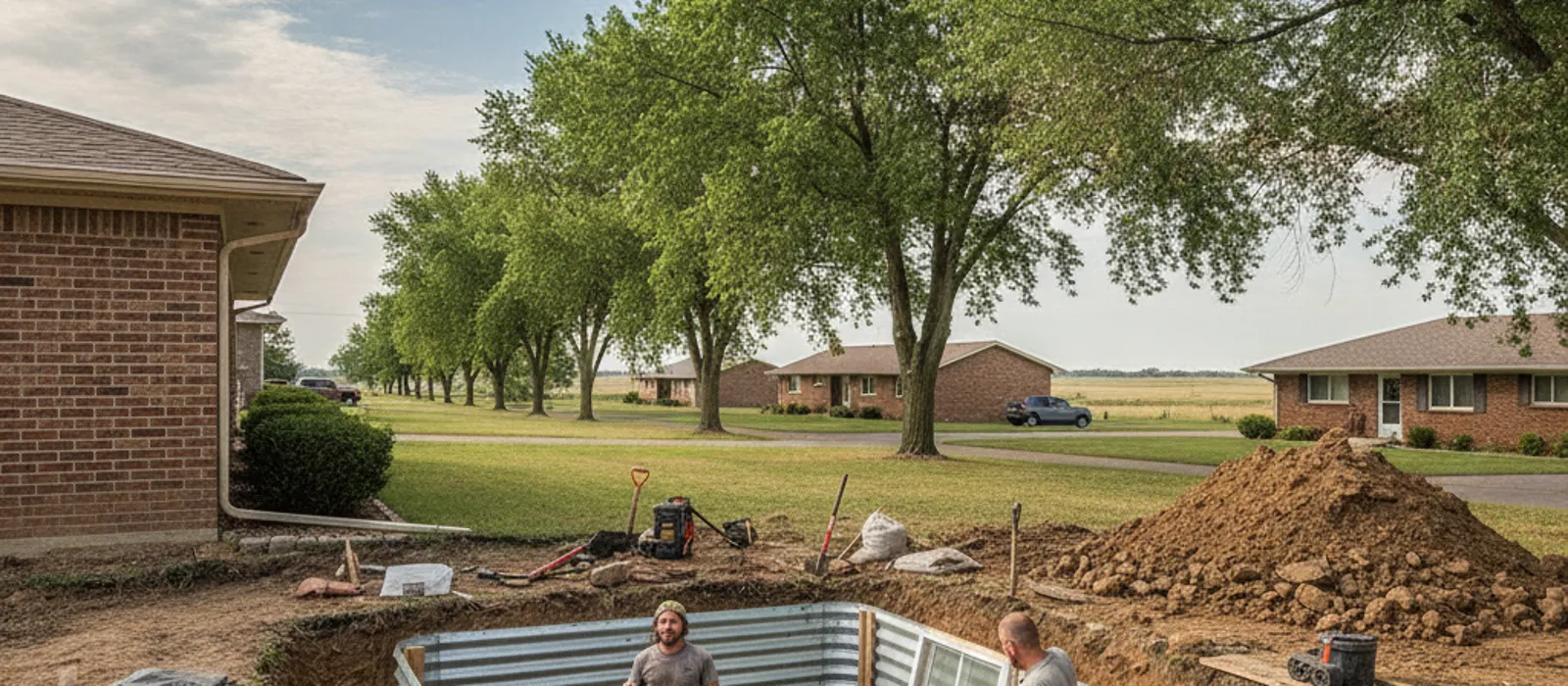
A homeowner in Hickman spent a Saturday cutting into his foundation with a rented concrete saw, confident he’d save a few thousand dollars on a basement bedroom window. Three days later a crack ran from the new opening toward his footing, and the fix cost more than the whole project would have if he’d hired it out from the start.
That’s the short version of DIY egress window installation risks: the job looks like a weekend project until concrete, water, or code steps in. Egress windows aren’t just bigger basement windows. They’re a structural cut into your foundation wall, tied to strict size and safety rules, and a single bedroom in Lincoln can’t legally be sold or rented as a bedroom without one that meets code.
This article walks through what actually goes wrong when homeowners DIY an egress window, what those mistakes cost to fix, and where the line is between a reasonable weekend task and a job you should hand to a licensed contractor. If you’re already picturing a crack in your foundation or a flooded window well, call us at (402) 261-0485 and we’ll walk the site with you before you touch a saw.
Why DIY Egress Window Installation Risks Are Higher Than They Look
On paper, an egress window installation is four steps: cut the opening, frame it, set the window, and build the well. In practice, every one of those steps touches something that’s expensive to get wrong.
Cutting concrete foundation walls means finding rebar without breaking it, sizing the opening within a few inches of code minimums, and keeping the wall above the cut from settling while it’s unsupported. Framing means matching the header to the load above it, not just screwing in whatever lumber is handy. Setting the window means getting the sill height and flashing right so water runs away from your basement instead of into it. And the well needs drainage that actually drains, not just a gravel-lined pit that looks the part until the first hard rain.
Miss any one of those and you’re not looking at a cosmetic problem. You’re looking at water in the basement, a window that won’t open in an emergency, or a wall that needs structural repair. Lincoln’s freeze-thaw cycles make sloppy work worse over time, not better, because a small gap or crack this fall becomes a bigger one by spring.
Three Southeast Nebraska Homeowners, Three DIY Lessons
Waverly: the well that never drained. Dan in Waverly installed a prefab window well himself after replacing his basement window, but skipped the gravel drainage bed and didn’t tie it into a drain line. The well filled during spring runoff and pushed water against the foundation. He ended up paying $1,100 to have the well pulled, a proper gravel and drain system installed, and the well reset, on top of the $500 he’d already spent on the well and window.
Seward: the opening that came in half an inch short. Todd, who lives just outside Seward, cut his own opening based on measurements from an online guide, not the specific egress window he’d bought. The rough opening came in narrow, and the window he’d already purchased didn’t fit without re-cutting the concrete. Round two of the cut, plus a new header and finish work, added roughly $2,200 to a project he’d budgeted at $1,800.
Crete: the crack that showed up under the siding. In Crete, Marisol’s DIY cut-in for a basement bedroom window left a hairline crack running from the new opening’s corner toward the footing. It wasn’t visible until she started patching drywall inside and noticed a matching line. A structural engineer’s assessment and the repair work ran close to $3,000, well above what a licensed egress window cut-in would have cost in the first place.
None of these homeowners were careless people. They were doing what a lot of confident DIYers do: following general instructions for a job that’s actually site-specific. If any of that sounds like where your project is headed, get in touch through our contact page before the concrete cut, not after.
Structural and Foundation Risks You Can’t Undo With a Second Coat of Caulk
The biggest DIY egress window installation risks aren’t cosmetic. They’re structural, and they don’t always show up right away.
Cutting a new opening removes load-bearing concrete or block from your foundation wall. Without a properly sized header and temporary shoring during the cut, the wall above the opening can settle or crack. That crack might not appear the day of the cut. It can show up weeks or months later as the wall adjusts, which makes it hard to trace back to the original work and easy to blame on something else.
Rebar is the other hidden hazard. Cutting through structural rebar without knowing it’s there, or without compensating for it, weakens the wall in exactly the spot that needs to be strongest. A rented saw and a YouTube video won’t tell you where the rebar runs in your specific foundation.
This is the point where we tell you plainly: if the job involves cutting concrete or block, or any work that touches your home’s structural wall, that’s not a DIY task. Hire a licensed contractor. The same goes for any electrical work near a window well, especially if you’re adding well lighting or running power nearby. Water and electricity close to a below-grade window well are a bad combination for a DIY afternoon.
Digging out a window well opening carries its own hazard too. Federal workplace safety data from the Occupational Safety and Health Administration shows that trench and excavation cave-ins are one of the most dangerous parts of any dig, even a shallow one around a foundation. A window well excavation is usually small, but the same collapse risk applies if the soil is loose or saturated.
Code, Permit, and Resale Risks That Cost You Later
Even a structurally sound DIY egress window can fail you on paper. Lincoln and Lancaster County require permits for egress window installation, and the opening has to meet specific minimum size, sill height, and window well dimensions to legally count as a bedroom exit. Skip the permit or miss the numbers by an inch and you’ve got a window that looks right but doesn’t count.
That matters most when you sell. A basement bedroom without a code-compliant egress window isn’t legally a bedroom, and that comes out during a home inspection or an appraisal. Buyers’ agents ask about it. Appraisers downgrade the room. You can end up renegotiating your sale price over a window that a $75-$200 permit and a code check would have caught years earlier.
The IRC (International Residential Code) sets the baseline egress requirements that most Nebraska jurisdictions adopt locally, covering minimum net clear opening, maximum sill height above the floor, and window well dimensions when the sill sits below grade. The City of Lincoln’s Building and Safety homeowner permit page lays out when a permit is required for residential work, and your specific numbers should always be checked against that current adopted code before you cut anything. We cover the full breakdown in our post on IRC egress window code requirements.
If you already suspect your window doesn’t meet code, whether it was a DIY job or something done by a previous owner, don’t wait for a sale to find out. A quick inspection is a lot cheaper than a renegotiated closing. Call (402) 261-0485 and we’ll tell you straight whether it passes.
DIY vs. Professional Egress Window Installation: A Cost Comparison
Here’s how the numbers actually compare once you account for the mistakes that show up in DIY jobs.
| Scenario | Typical Cost | Common DIY Add-On Costs |
|---|---|---|
| Professional new cut-in install | $3,500-$7,000 (full Lincoln jobs with well and finishing often $5,500-$9,500) | N/A, done right the first time |
| Professional egress replacement (existing opening) | $1,200-$3,000 | N/A |
| DIY cut-in gone wrong (re-cut, structural repair) | Starting materials $1,800-$2,500 | Add $2,000-$3,000+ for structural fixes, per real cases above |
| DIY window well without drainage | $500-$800 in materials | Add $1,000-$1,500 to correct drainage after flooding |
| Building permit (Lincoln/Lancaster County) | $75-$200 | Re-inspection fees if work fails first pass |
The pattern is consistent. DIY installation can save money when the scope is small, like swapping a basement window that isn’t below grade, which typically runs $400-$1,200 either way. But once you’re cutting concrete or building a well with real drainage requirements, the risk of a costly do-over usually outweighs the upfront savings. Our egress window cost page has a full pricing breakdown if you want the details before you decide which way to go.
What’s Reasonable to DIY, and What Isn’t
Not everything about an egress window project is off-limits for a capable homeowner. It helps to know where the reasonable line sits.
Reasonable for most DIYers:
- Cleaning out an existing window well and clearing debris
- Installing a window well cover or ladder on an already-compliant well
- Basic landscaping and grading around a well to improve surface drainage
- Painting or finishing trim on an already-installed window
Not reasonable without a licensed contractor:
- Cutting concrete or block foundation walls
- Sizing and installing a structural header
- Any electrical work near or inside a window well
- Determining code compliance for a bedroom egress opening
- Correcting a foundation crack or settling issue
If your project falls in that second list, it’s worth reading our post on cheap egress window installation risks before you get quotes, since a lot of the same corner-cutting that shows up in bargain contractor bids shows up in DIY jobs too. A licensed installer working from our egress window installation page carries the liability, pulls the permit, and knows the local code numbers cold, which is exactly the part that trips up DIYers.
When a Small DIY Mistake Becomes an Expensive One
The Ashland homeowners who called us after their DIY well backfilled with mud during a spring storm weren’t unusual. Most DIY egress window problems don’t start as disasters. They start as small shortcuts: a drainage layer skipped to save an hour, a measurement eyeballed instead of double-checked against the window’s actual spec sheet, a permit skipped because the paperwork seemed like overkill for “just a window.”
Those shortcuts compound. Water finds the low spot. A slightly-off opening means a window that seals poorly. A skipped permit means no one checked the sill height, and you don’t find out it’s wrong until an inspector or a buyer’s agent does.
If you’re partway into a DIY egress window project and something feels off, whether it’s water pooling, a crack you didn’t expect, or a window that won’t seat right, stop before you go further. A quick call often costs nothing and can save you from turning a small fix into a big one. Reach us through our contact page or at (402) 261-0485, 24/7 for anything time-sensitive like a closing deadline or storm damage.
Frequently Asked Questions
Can I install an egress window myself without a permit?
Technically you can attempt the work, but Lincoln and Lancaster County require a permit for egress window installation because it involves structural changes to your foundation. Skipping the permit means no one verifies the opening meets code, which can cause problems at resale or during a home inspection. The permit itself typically runs $75-$200, which is inexpensive compared to fixing a non-compliant opening later.
What’s the most common mistake in DIY egress window installation?
Skipping proper drainage in the window well is one of the most common issues, along with cutting the concrete opening to the wrong dimensions for the specific window purchased. Both mistakes are avoidable with careful planning but expensive to fix once the concrete is cut or the well is backfilled.
How do I know if my basement window needs a full egress upgrade or just a replacement?
If the opening is already correctly sized and simply needs a new window unit, that’s a replacement, typically $1,200-$3,000 in an existing opening. If there’s no opening at all, or the current one is too small to meet code, you need a full cut-in installation, generally $3,500-$7,000. We cover the difference in more detail in our repair vs. replace egress window post.
Is it ever safe to DIY the concrete cutting for an egress window?
We don’t recommend it. Cutting a foundation wall risks structural cracking, and rebar in the wall can be in places you don’t expect. This is one of the clearest lines between DIY-friendly tasks and jobs that need a licensed, insured contractor, both for your safety and for the integrity of your foundation.