
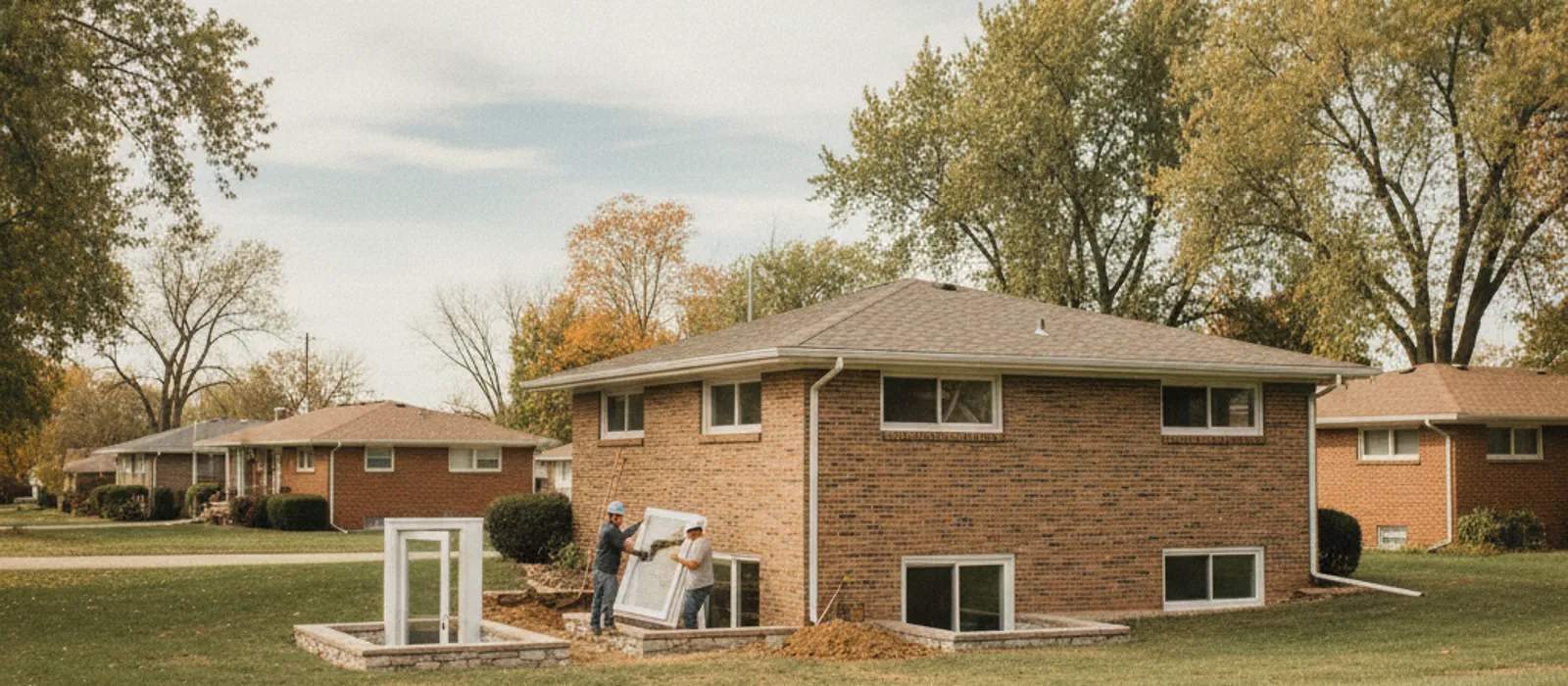
A code inspector can fail the exact same basement bedroom twice for the exact same reason: the wrong window style in the opening. Casement, slider, and in-swing units all technically open wide enough to count as an exit, but only one of them usually fits a narrow window well, and only one holds up in a tight side yard. If you’re staring down a basement remodel or a closing deadline, the casement vs slider vs in-swing egress window decision matters just as much as the price on the estimate.
This guide walks through how each style opens, what it costs installed in Lincoln, and which one actually fits your window well without a redo. We’ll also cover the one style most homeowners in our service area never need, and why.
If you’d rather skip the research and just get a straight answer for your specific window well, call (402) 261-0485 or request a free written estimate and we’ll tell you which style fits.
What Sets Casement, Slider, and In-Swing Egress Windows Apart
Every egress window has to clear the same code baseline no matter what style you pick. Nebraska follows the International Residential Code, which requires a net clear opening of at least 5.7 square feet, a minimum opening height of 24 inches, a minimum opening width of 20 inches, and a sill no higher than 44 inches off the finished floor. Our page on egress window size requirements in Nebraska breaks those numbers down further if you want the full detail.
Where the three styles differ is how they get to that net clear opening, and what that means for the space around them.
- Casement windows are hinged on one side and crank outward, so nearly the entire window opening becomes usable escape space when it’s fully open.
- Slider windows have one fixed panel and one panel that slides horizontally, so only about half of the total window width ever opens, which means the whole unit has to be bigger to meet code.
- In-swing windows hinge inward and open into the room instead of out into the well, a layout reserved for tight spots where an outward swing would hit something outside.
If you want the exact code language, our post on IRC egress window code requirements walks through the full checklist.
Casement Egress Windows: Best for Tight Window Wells
Casement egress windows are the most common style we install across Lincoln and the surrounding towns, and there’s a simple reason why. Because the sash cranks nearly fully open, a casement window doesn’t need extra width in the well to reach its net clear opening. That makes it the easiest style to fit into a standard window well without digging the well any wider than it already is.
In Waverly, a homeowner named Marcus was finishing his basement into a fourth bedroom and had a window well that had been sitting narrow and unused for years. A slider would have meant excavating the well a foot wider on each side to hit the required net clear opening. His contractor installed a casement unit in the existing rough opening instead, and the full job, window and well work included, came in at $2,850. No extra digging needed.
Casement windows also seal tighter against drafts than sliders because the crank mechanism compresses the sash against the frame rather than relying on a sliding track. That’s a real plus in a Nebraska winter, when every gap around a basement window turns into a cold spot.
Not sure whether your current well can handle a casement swap without an upgrade? A quick estimate settles it fast. Call (402) 261-0485 or request a free written estimate and we’ll tell you exactly what fits.
Slider Egress Windows: Budget-Friendly but Limited Clearance
Slider egress windows have their place, especially in a wide window well where space isn’t the limiting factor. Because only half the window opens at once, a slider has to be a larger overall unit to meet the same 5.7 square foot net clear opening as a smaller casement. That usually means a wider well, more excavation, and a bigger rough opening in the foundation.
The upside is price. Slider hardware is simpler than a casement crank mechanism, and the frames are often less expensive per square foot. For a homeowner who already has a generously sized well, a slider can be the more affordable path to code compliance.
In Seward, a homeowner named Diane wanted to keep costs down while finishing a basement guest room. Her existing well was already wide from an old construction-era opening, so a slider egress window fit without any well modification at all. The replacement in the existing opening ran $1,650, on the lower end of the typical $1,200-$3,000 range for that kind of swap.
Where sliders get expensive fast is when the well isn’t wide enough already. Widening a well means new excavation, a new liner, and sometimes a permit revision, which can push a project from a simple $1,200 swap into a $4,000-plus job once digging is involved. If your frame is original to the house, our post on vinyl vs. wood egress window frames is worth a read before you decide between a repair and a full replacement.
In-Swing Egress Windows: Rare, and Usually a Last Resort
In-swing egress windows are the style you’ll see the least in our service area, and that’s by design. Because the sash opens into the room instead of out into the well, in-swing units are typically reserved for situations where something outside physically blocks an outward-opening window, like a deck support post, a retaining wall, or a buried utility line too close to the foundation to move.
The tradeoff is real. An in-swing sash takes up floor space inside the bedroom when it’s open, which can conflict with furniture placement, closet doors, or a required clear path to the exit. Some jurisdictions also restrict how far an in-swing window can encroach into the room, so this isn’t a style to choose casually.
Out in Crete, a family remodeling their basement had a walkout patio built just eighteen inches from their old basement window, leaving no room for an outward-swinging sash. Rather than force a casement or slider into a space that couldn’t accommodate it, their contractor installed an in-swing unit and repositioned the bed frame to keep the swing path clear. The new cut-in install, patio obstruction and all, ran $6,200.
Before choosing in-swing for a similar reason, it’s worth getting a second opinion. In most cases, regrading the well or trimming back an obstruction costs less over the life of the window than living with a sash that opens into your bedroom every time there’s a fire drill. Our egress window installation page covers how we evaluate a site before recommending any particular style.
Casement vs. Slider vs. In-Swing Egress Window: Cost, Clearance, and Code Compared
Here’s how the three styles stack up side by side. Actual pricing depends on your opening size, well condition, and whether excavation is needed, but this gives you a starting point.
| Feature | Casement | Slider | In-Swing |
|---|---|---|---|
| How it opens | Cranks outward, hinged on one side | Slides horizontally, one panel fixed | Swings inward into the room |
| Net clear opening efficiency | High, most of the frame counts | Lower, only about half opens | High, most of the frame counts |
| Typical window well width needed | Standard | Wider than standard | Standard or narrow |
| Draft and seal performance | Tightest seal | Moderate, track allows some leakage | Tight, but interior swing space required |
| Replacement in existing opening | $1,200-$3,000 | $1,200-$3,000 | $1,200-$3,000 |
| New cut-in install (well included) | $3,500-$7,000 | $4,000-$7,500 if well widening is needed | $3,500-$7,000 |
| Best for | Narrow or standard wells, cold climates | Wide, already-oversized wells | Blocked or obstructed exterior space |
Which Style Actually Fits Your Basement Bedroom
Start with what you already have outside, not what you’d prefer inside. Measure the current window well or the space where a new one would go, and check for anything within a couple feet of the foundation wall, like a deck post, gas line, or property line setback.
If the well is standard width or narrow, a casement window almost always gets you to code without extra excavation. If you’ve already got a wide well from an older construction style, a slider can save money without any downside. In-swing only makes sense when something outside genuinely can’t move, and even then it’s worth a professional opinion first since it changes how the bedroom itself functions.
Permits in Lincoln typically run $75-$200 depending on the scope of work, and that cost is the same no matter which style you choose. What changes is the labor and materials behind it. If you’re weighing the full cost picture across styles and scopes, our egress window cost page has the complete breakdown, including when it’s smarter to fix what’s there instead of swapping styles entirely.
Ready to find out which style fits your well without guesswork? Call (402) 261-0485 or get a free written estimate and we’ll measure it out before you commit to anything.
When to Call a Professional Instead of Handling It Yourself
Picking a window style is one decision. Cutting the foundation, widening a well, or rerouting anything electrical near the opening is a different job entirely, and it’s not one to take on yourself.
Stop and call a licensed contractor when your project involves any of the following:
- Enlarging a rough opening in the foundation, which is structural work
- Widening or deepening a window well, which usually means excavation near the foundation footing
- Any electrical conduit or lighting running near or through the well area
- A well wall that’s already bowing, cracking, or pulling away, which can complicate installation of any style
According to Ready.gov, every bedroom needs two ways out in case of fire, and a basement bedroom’s second way out is almost always its egress window, which is exactly why getting the style and clearance right matters so much (Ready.gov, Home Fire Safety). The U.S. Department of Energy also notes that window type has a real effect on air leakage and energy performance, with tighter-sealing styles like casements generally outperforming sliding designs in colder climates (Energy.gov, Update or Replace Windows).
If your basement bedroom needs to stay legal for a future sale, the window style you pick now can affect how easily it passes inspection later. That’s worth thinking through before, not after, the well gets dug.
Frequently Asked Questions
Which egress window style is cheapest to install?
Slider windows are often the cheapest option when the existing well is already wide enough to meet code, since the hardware itself costs less than a casement crank mechanism. But if the well needs to be widened to fit a slider’s larger footprint, a casement in the same narrow well usually ends up cheaper overall.
Can I switch from a slider to a casement egress window without redoing the window well?
In most cases, yes. Because casement windows use more of their frame as net clear opening, they typically fit into the same or a smaller well than a slider needs. A quick measurement during a free estimate will confirm whether your specific well works as-is.
Are in-swing egress windows allowed in Lincoln, NE?
Yes, in-swing windows meet code as long as the swing path doesn’t block a required clear path inside the room. They’re uncommon because most homeowners prefer an outward-opening style, but they’re a legitimate option when something outside the foundation blocks a casement or slider from opening properly.
How much window well width do I need for each style?
Casement and in-swing windows generally fit standard window wells because most of the sash counts toward the net clear opening. Slider windows need a wider well, often several inches to a foot more on each side, since only half the unit opens. Exact clearance depends on your specific window’s dimensions, which we measure on-site before recommending a style.